
There is a moment, just before the music begins, when the costume already starts telling its story.
A length of velvet catches the stage light. A train rests quietly on the floor. A pointed hem waits to carve invisible lines through the air. Before the first step is taken, the audience has already entered another world.
That is the essence of modern flamenco fusion.
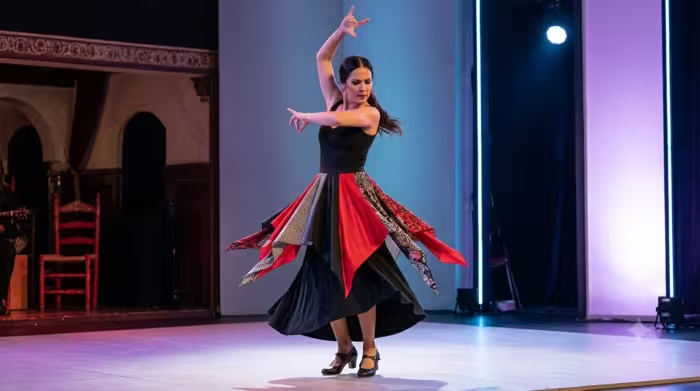
Rather than reproducing the traditions of classical flamenco exactly as they have been preserved for generations, flamenco fusion embraces dialogue. It speaks with contemporary dance, tribal fusion belly dance, gothic aesthetics, theatre, cinematic storytelling and experimental stage design. It respects the expressive power of flamenco while allowing choreographers and costume designers to explore new visual languages.
The emotional intensity remains unmistakably flamenco—pride, longing, strength, vulnerability and passion—but the visual vocabulary expands far beyond the traditional stage.
A modern flamenco fusion costume might combine fitted trousers beneath an overskirt, layered textiles inspired by historical garments, embroidered tribal belts, dramatic veils, asymmetrical silhouettes or richly textured fabrics that respond beautifully to theatrical lighting. Instead of following a single historical tradition, every costume becomes a carefully designed composition where movement, light and fabric work together.
This is perhaps the greatest difference between classical flamenco and flamenco fusion.
Traditional flamenco costumes are deeply connected to their own heritage. The iconic ruffled dress, the bata de cola, fitted bodices and structured silhouettes have evolved over generations alongside the dance itself.
Modern flamenco fusion, however, treats costume as an artistic language rather than a fixed tradition.
Every garment is selected not only because it looks beautiful, but because it changes the way movement is perceived. Layers become choreography. Textures become shadows. Fabrics become extensions of the dancer’s emotions.
Among these elements, few are as versatile—or as expressive—as the overskirt.
Unlike a conventional skirt, an overskirt adds transformation without replacing the entire costume. It can appear for a single scene, disappear during another, or completely alter the dancer’s silhouette in a matter of seconds. It introduces depth, contrast and movement while allowing remarkable freedom for creative experimentation.
Today, several overskirt designs have become especially popular within modern flamenco fusion.
Asymmetrical Overskirts (Handkerchief or Pointed Overskirts)
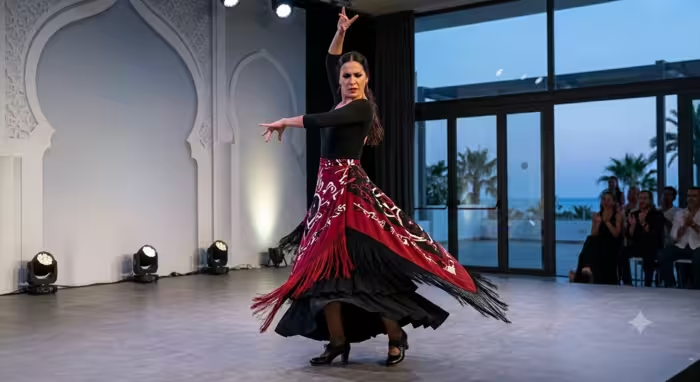
Inspired by the flowing geometry of Manila shawls and the decorative hip scarves of traditional flamenco, asymmetrical overskirts replace perfectly even hems with irregular points that seem to draw across the stage like brushstrokes.
Instead of creating identical movement in every direction, each point responds differently to gravity and momentum. The costume never repeats the same silhouette twice.
These overskirts are usually worn over fitted skirts or dance trousers, breaking the straight vertical line of the body and creating a more sculptural profile.
Their greatest strength appears during marcajes, travelling sequences and grounded footwork. The elongated side points visually reinforce weight transfers, allowing the audience to perceive subtle shifts that might otherwise remain unnoticed.
Lighting enhances their beauty even further. Side illumination catches each point independently, creating alternating highlights and shadows that continue moving even after the dancer has paused.
Rather than decorating the body, these overskirts extend its expressive language.
Open Overskirts with a Train: Reimagining the Bata de Cola
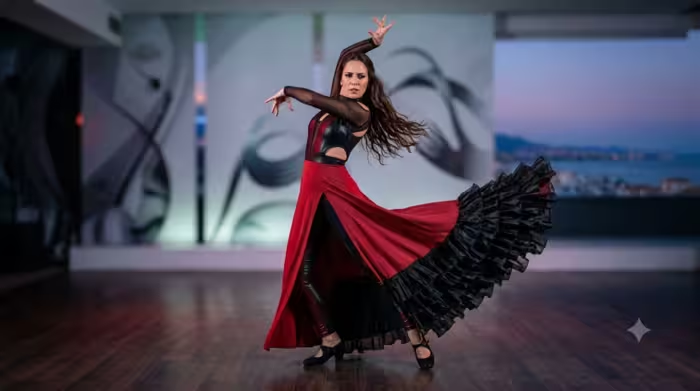
Few garments possess the dramatic presence of the traditional bata de cola.
Its sweeping train has become one of the great symbols of flamenco, demanding extraordinary technical skill while creating breathtaking visual poetry.
Modern flamenco fusion often reinterprets this masterpiece through a detachable overskirt.
Instead of constructing an entire heavy dress, designers attach an independent train around the waist, allowing it to flow over fitted trousers or a lightweight base skirt.
The result preserves much of the visual grandeur while offering considerably greater versatility.
The dancer gains freedom to transition between different movement qualities without carrying the full structural weight of a traditional costume.
The detachable train also expands creative possibilities. A performance can evolve visually as layers are added or removed, transforming the costume to match the emotional arc of the choreography.
Under backlighting, the train becomes almost ethereal. It lingers after every turn, traces invisible paths across the stage and continues speaking long after the body has become still.
Layered Overskirts (Multi-Panel Overskirts)
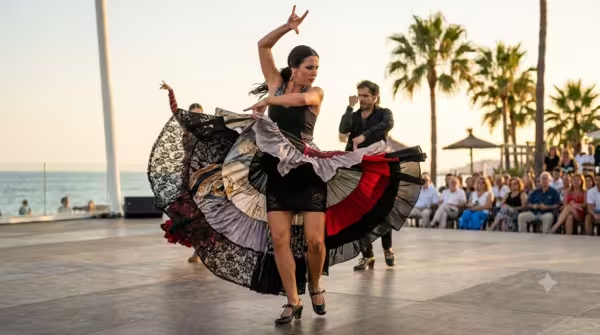
Some overskirts are designed not as a single continuous surface, but as collections of independent panels.
Long vertical gores, generous inserts or flowing fabric strips create garments that constantly open and close as the dancer moves.
During spins, these layers separate dramatically, revealing the costume beneath before folding together again.
This continual dialogue between concealment and revelation creates extraordinary visual depth.
Designers often exploit this structure by combining contrasting fabrics. Matte black velvet may briefly reveal metallic brocade. A printed underskirt may appear for only a fraction of a second before disappearing again. Rich colours hidden beneath darker outer layers suddenly emerge beneath the stage lights.
The overskirt becomes a living architecture.
Rather than moving as a single piece of fabric, every panel responds independently to acceleration, gravity and airflow, producing movement that feels organic and endlessly varied.
For photographers and filmmakers, layered overskirts are particularly rewarding because every frame captures a unique composition.
Overskirts with an Integrated Hip Belt

One of the most distinctive characteristics of flamenco fusion is its openness to influences from tribal fusion belly dance.
Overskirts with integrated hip belts beautifully illustrate this conversation between traditions.
A richly decorated belt—embroidered, adorned with tassels, metallic ornaments, coins or textured appliqués—anchors lightweight fabric panels that fall gracefully around the hips.
The construction serves both visual and choreographic purposes.
The structured belt clearly defines the pelvis, making isolations, figure eights, hip drops and weight shifts easier for the audience to perceive.
Meanwhile, the soft fabric below introduces fluidity that contrasts elegantly with the precision of flamenco technique.
This combination of architectural structure and flowing movement creates a fascinating visual balance.
The hips become the rhythmic centre of the costume while the fabric echoes every gesture with graceful continuity.
Choosing an Overskirt That Serves the Choreography
Every overskirt tells a different story.
Asymmetrical designs emphasize direction and changing silhouettes.
Open trains evoke grandeur, elegance and theatrical drama.
Layered overskirts celebrate motion itself, revealing hidden colours and textures with every spin.
Integrated hip-belt overskirts strengthen pelvic articulation while blending flamenco expression with tribal influences.
Rather than asking which design is the most beautiful, it is often more useful to ask what role the costume should play within the choreography.
Should it amplify powerful footwork?
Should it create larger silhouettes for a spacious theatre?
Should it reveal hidden layers under rotating stage lights?
Or should it guide the audience’s attention toward the subtle language of the hips?
The answer will determine not only the design of the overskirt, but also the fabrics, colours and construction techniques that best support the performance.
Final Thoughts
Modern flamenco fusion is not defined by abandoning tradition.
It is defined by allowing tradition to continue evolving.
Every overskirt carries echoes of classical flamenco while opening new possibilities through contemporary design. It transforms light into texture, movement into architecture and fabric into emotion.
When thoughtfully designed, an overskirt does far more than decorate a costume.
It becomes another dancer.
It breathes with every turn.
It catches every beam of light.
And in the silent spaces between one movement and the next, it continues telling the story that words alone could never express.