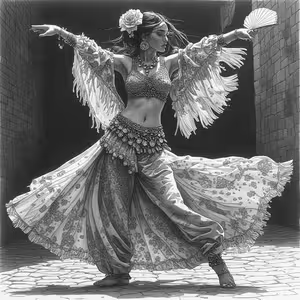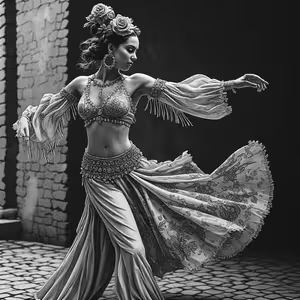
Between rehearsal light and stage fire
Burlesque cabaret is not merely a style of dance. It is a language of glances, a choreography of fabric, a negotiation between concealment and revelation. It lives in the shimmer of a glove being pulled slowly up the arm, in the weight of a corset tightening like a held breath, in the quiet confidence of a performer who knows exactly how they want to be seen.
To dress for burlesque is to dress for transformation. And yet, behind every feathered spectacle on stage, there is something far more grounded: rehearsal clothing, repetition, sweat, precision. The dual wardrobe—practice and performance—is where artistry becomes sustainable.
1. The Philosophy of the Burlesque Look

Before talking about garments, let’s talk about intention.
Burlesque style is built on contrast:
- softness and structure
- control and abandon
- modesty and suggestion
- everyday repetition and rare theatrical eruption
A good burlesque look is never just “beautiful.” It is intentional. Every piece must answer a question: What am I revealing? What am I protecting? What story is this fabric telling when I move?
2. Rehearsal Wear: The Invisible Architecture of Glamour
Rehearsal is where glamour is trained into the body. It is not about impressing anyone—it is about function, awareness, and repetition.
Key principles:
- Freedom of movement first. If you cannot turn, drop, or isolate your hips freely, the outfit is failing you.
- Layer like a technician. Rehearsal is where you test costume logic: straps, closures, corset lines, stockings, shoes.
- Visibility of alignment. Choose clothing that lets you see your body working.
Practical rehearsal wardrobe ideas:
- High-waisted leggings or dance shorts that allow pelvic movement clarity
- Soft corsets or lace-up bodices used as training versions of stage pieces
- Fitted tank tops or mesh tops that reveal posture and shoulder engagement
- Convertible heels or character shoes worn repeatedly to break them in
- Simple robes or wrap skirts for quick transitions between drills
A hidden truth:
Rehearsal clothing is not “less important” than stage wear. It is the skeleton. If it fails, the stage collapses later.
Think of rehearsal attire as truth clothing: it shows you where your technique is honest—and where it still needs discipline.
3. Performance Wear: When Fabric Becomes Character
On stage, clothing stops being functional and becomes narrative.
Burlesque costumes often work like architecture:
- corsets as structure
- stockings as rhythm lines
- feathers as movement extension
- gloves as punctuation
Key elements of a strong stage look:
Corsetry and structure
A corset is not just decoration. It shapes posture, breath, and presence. A well-fitted corset should enhance alignment, not imprison it.
Layered removal potential
Burlesque lives in transformation. Ask yourself:
- Can this be peeled, unbuttoned, unzipped, or revealed in stages?
- Does each layer have its own visual identity?
Texture storytelling
Combine contrasts:
- satin vs lace
- velvet vs mesh
- rigid boning vs floating fringe
Footwear as punctuation
Shoes are not background—they are rhythm. They complete the line of the body.
Practical advice:
- Always rehearse costume changes, not just choreography
- Break in everything before stage night
- Secure all detachable elements (safety pins are not optional—they are allies)
- Test visibility under stage lighting, not just mirrors
4. The Body After 50: Presence, Power, and Ease
There is a quiet misconception that burlesque belongs to youth. The stage knows better.
A performer over 50 brings something no younger body can manufacture: time lived inside movement. The costume should not hide that—it should honour it.
The guiding principle:
Not concealment, but comfort with presence.
What to prioritize:
- Support over restriction. Choose corsetry and underlayers that respect breath and posture.
- Weight balance. Heavy costumes should be distributed so the body feels held, not burdened.
- Skin confidence. If skin is shown, it is not an apology—it is part of the visual language.
- Ease of entry and exit. Costumes should be manageable without stress backstage.
Styling notes:
- Draped fabrics can soften lines while enhancing movement flow
- Sleeves, shawls, and flowing panels can extend gesture beautifully
- Strategic coverage can be expressive, not defensive
A deeper truth:
Stage presence at this stage of life often becomes more magnetic, not less. The goal is not to “compete with youth,” but to inhabit space with authority and ease.
The body is not something to correct. It is something to arrive with.
5. Feminine Presentation in Performance: Expression Without Labels
Burlesque cabaret has always been a home for transformation. Within it, many performers explore femininity as costume, character, or extension of self-expression.
Some arrive already fluent in this language; others are still discovering its grammar. The stage does not require explanation—only presence.
Key styling principles:
- Silhouette clarity. Whether bold or subtle, the outline of the body should feel intentional.
- Balance of softness and control. Feminine-coded aesthetics often rely on contrast: structured corsets with fluid fabrics, sharp makeup with soft textures.
- Comfort as foundation. No aesthetic choice should compromise safety, movement, or breath.
Costume approach:
- Wigs, makeup, and accessories should feel like extensions, not disguises
- Layers can be used to build transformation moments during performance
- Gloves, stockings, and jewelry often become expressive tools, not just decoration
A respectful truth:
There is no single way to embody femininity on stage. It is not a fixed category—it is a spectrum of artistic expression. The most powerful performances come not from fitting a mold, but from shaping one’s own visual language with confidence.
6. Final Notes: Dressing as Ritual
In burlesque, getting dressed is never neutral. It is preparation, invocation, and focus.
Rehearsal wear teaches the body honesty.
Performance wear teaches it elevation.
Between them lies the artist.
A few closing principles worth carrying into every dressing room:
- If it restricts your breath, it restricts your art.
- If it distracts you constantly, it is not yet ready for stage.
- If it makes you feel like someone else in a good way, you are probably on the right path.
Burlesque is not about becoming someone new.
It is about revealing, layer by layer, the version of yourself that already knows how to stand under light and not flinch.
And in the end, the most important costume is never fabric.
It is confidence worn from the inside out.