
Styling for Dancers: There are bodies that enter a room like a whisper, and others that arrive like a chord struck cleanly across the air. Broad or prominent shoulders belong to the latter—they carry presence, intention, architecture. In dance, this is not a flaw to soften, but a line to understand, to work with, to compose around.
Styling, then, is not correction. It is orchestration.
When the shoulders hold visual weight, the goal is not to diminish them, but to create harmony across the entire body—so that the eye travels, rests, and returns without resistance. The costume becomes a continuation of choreography: guiding attention, shaping rhythm, framing movement.
Let’s move from poetry into practice.
1. Understanding Visual Balance on Stage
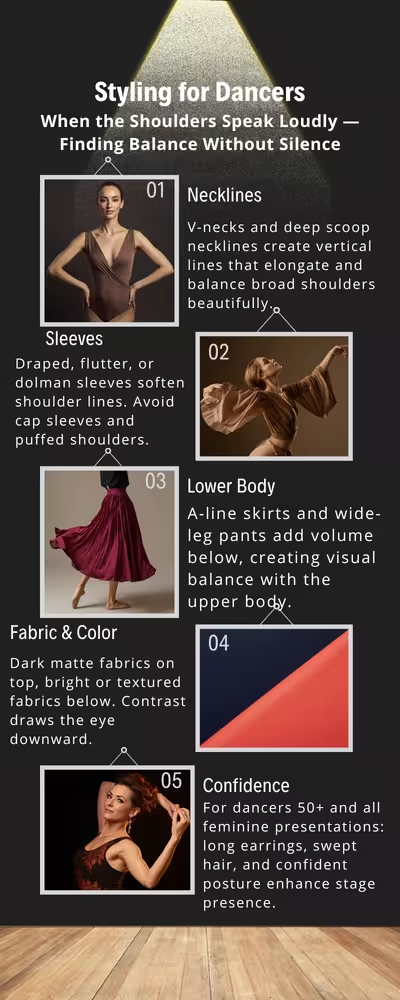
The audience reads the body in fractions of a second. Shoulders that appear broad can dominate the upper silhouette, especially under stage lighting. This can be powerful—but if everything gathers there, the rest of the body may disappear.
Balance comes from distribution of visual interest:
- Width vs. length
- Structure vs. fluidity
- Light vs. shadow
- Detail vs. simplicity
Your task is not to “reduce” the shoulders, but to invite the gaze elsewhere as well.
2. Necklines: Where the Eye Begins
Necklines are one of the most effective tools.
Best allies:
- Deep V-necks: They create a vertical pathway, drawing the eye downward.
- Wrap styles: They introduce diagonal lines, breaking horizontal width.
- Asymmetrical cuts: These disrupt symmetry, softening the sense of breadth.
Approach with care:
- Boat necks and straight-across tops: These emphasize horizontal lines.
- Halter necks: They can highlight shoulder width unless balanced with volume below.
Practical tip:
If you love a neckline that emphasizes the shoulders, don’t abandon it—counterbalance it with stronger elements in the lower half (volume, texture, movement).
3. Sleeves and Straps: Framing the Frame
The instinct might be to “cover” the shoulders, but coverage alone is not the solution.
What works:
- Soft, draped sleeves (mesh, chiffon): They blur the edge of the shoulder line.
- Drop-shoulder seams: They shift the visual starting point outward in a gentler way.
- Thin or strategically placed straps: These can actually reduce visual bulk compared to thick bands.
What to reconsider:
- Rigid cap sleeves: They often create a shelf-like effect.
- Overly structured shoulders (pads, stiff fabrics): Unless used intentionally for character, they amplify presence.
4. The Power of the Lower Body
If the shoulders speak loudly, let the hips, legs, and feet answer.
Balance strategies:
- A-line skirts or layered panels: Add movement and width below.
- Textured or embellished bottoms: Sequins, fringe, or patterns draw attention downward.
- High-waisted designs: They elongate the legs and shift proportion.
For dancers, movement is key:
- Fringe that reacts to rhythm
- Fabric that catches air during turns
- Slits that reveal lines in motion
The goal is to activate the entire silhouette, not leave the upper body doing all the visual work.
5. Fabric and Color: Light as a Tool
Stage lighting exaggerates everything.
Use it intentionally:
- Darker or matte tones on the upper body can reduce visual density.
- Lighter, reflective, or textured fabrics below attract attention downward.
- Vertical gradients (darker top, lighter bottom) create flow.
But remember: contrast is a tool, not a rule. Sometimes a bold, unified color works beautifully—if the cut supports balance.
6. Hair and Accessories: Invisible Choreography
Hair is often overlooked, but it frames the shoulders directly.
Helpful approaches:
- Volume at the crown rather than the sides
- Length that extends below the shoulders
- Styles that create verticality (updos, elongated shapes)
Accessories:
- Long necklaces or vertical embellishments
- Waist accents (belts, sashes)
- Anklets or detailed footwear for styles where feet are visible
Each element says to the audience: look here too.
A Note for Dancers Over 50
There is a quiet violence in the idea that the body must be hidden with age. Dance knows better.
Your body is not something to negotiate with—it is something you have earned.
If your shoulders carry presence, they also carry history: years of training, of holding space, of expressing what cannot be spoken.
Styling at this stage is not about correction. It is about comfort, dignity, and resonance.
Practical considerations:
- Choose fabrics that move with you, not against you
- Prioritize breathability and ease of motion
- Use layering intelligently—light layers can create softness without restriction
Aesthetic considerations:
- Elegant lines over excessive complication
- Details that feel intentional, not decorative for the sake of distraction
- Colors that reflect how you want to be seen—not how you are told to fade
Most importantly:
Confidence is not an accessory you add at the end. It is the foundation upon which everything else rests.
When you feel at ease, the audience feels it too.