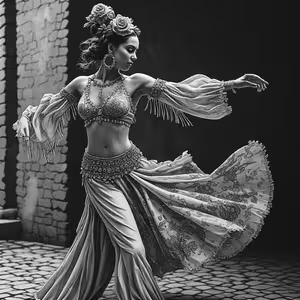
In a dimly lit studio, long before any dancer lifts a foot from the ground, shadows begin their quiet rehearsal. They stretch along the wooden floor, slide across mirrored walls, and bend gently with every flicker of light. For centuries, dance has been a dialogue between the human body and these shadows—movement translated into fleeting shapes. Today, a new figure steps into this ancient conversation: the virtual ballerina.
She does not breathe. She does not tire. Yet she moves.
Her arrival is not a sudden miracle but the result of decades of technological curiosity and artistic ambition. The virtual ballerina is born at the intersection of motion capture, computer graphics, artificial intelligence, and the enduring human desire to preserve movement beyond the limits of flesh. She is both a technical achievement and a philosophical question: what becomes of dance when the dancer is made of code?
This is the story of how shadows learned to dance on their own.
The Ancient Desire to Capture Movement
Dance is one of humanity’s oldest forms of expression. Long before written language, people used their bodies to tell stories, celebrate harvests, mourn losses, and communicate with the divine. But dance has always suffered from a peculiar fragility: it vanishes the moment it is performed.
A painting remains on canvas. A sculpture remains in stone. Music can be written into notation. But choreography, historically, lived only in memory and muscle.
Efforts to preserve dance began centuries ago. In the seventeenth century, choreographers experimented with symbolic systems to record steps and gestures. These early notations were clever but incomplete; they could describe patterns but not the subtlety of breath, timing, or emotional weight.
Later came film. Cameras allowed audiences to witness performances long after the curtain fell. Yet film still captured only a single viewpoint. It preserved the image of the dancer, not the structure of the movement itself.
The dream persisted: to capture dance not just as an image, but as a living structure of motion.
The virtual ballerina begins with that dream.
From Flesh to Data: The Rise of Motion Capture
The technical foundation of the virtual ballerina lies in motion capture—often called mocap. At its simplest, motion capture records the movement of a human body and translates it into digital coordinates.
A dancer enters a studio wearing a special suit dotted with reflective markers. Cameras surround the space, tracking each marker as it moves through three-dimensional space. Every twist of the wrist, every turn of the ankle, every arc of the spine becomes numerical data.
What emerges is a digital skeleton.
This skeleton does not look like a dancer. It is a collection of points and lines—hips, knees, shoulders, elbows—moving through an invisible grid. Yet within those lines lies the essence of choreography.
Once captured, the data can be applied to a digital model. The skeleton animates a computer-generated body: perhaps a classical ballerina, perhaps a fantastical creature, perhaps something entirely abstract.
In practical terms, motion capture allows choreographers to:
- Archive complex movements with extreme accuracy
- Analyze technique in slow motion
- Transfer choreography to digital characters
- Create performances impossible in the physical world
But motion capture alone does not create a virtual ballerina. It only records the dancer. The next step is teaching the computer to understand movement itself.
When Algorithms Learn to Dance
The virtual ballerina truly comes alive when artificial intelligence enters the studio.
Machine learning systems can study thousands of recorded dance movements and begin to recognize patterns: balance, rhythm, transitions between poses, the physics of a leap. Over time, the system can generate new movements that resemble those patterns without directly copying them.
This process transforms dance from something merely captured into something computationally explored.
Imagine feeding an AI a library of classical ballet performances. The system begins to recognize the structure of ballet vocabulary—arabesques, pirouettes, jetés. It learns how dancers move between these positions, how momentum carries the body, how balance is maintained.
Then, given a musical input or choreographic constraint, the AI proposes new sequences.
The result is not always perfect. Some movements may be awkward or physically impossible. But others are surprisingly elegant—steps that feel authentically human despite emerging from algorithms.
Here the virtual ballerina becomes not only a digital performer but also a collaborator.
The Digital Stage
Where does a virtual ballerina perform?
Everywhere.
Unlike traditional dancers, digital performers are not bound by gravity, architecture, or even anatomy. A virtual stage can exist in a theater, on a phone screen, inside a video game, or within immersive virtual reality.
Consider several emerging forms of digital performance:
1. Virtual Concerts and Performances
Entire ballet productions can now be staged with digital dancers. Lighting, sets, and choreography are simulated in real time. Audiences watch from multiple perspectives, sometimes even moving through the performance space.
2. Interactive Dance Experiences
In virtual reality environments, viewers may stand inside the choreography itself. The dancer moves around them, and sometimes responds to their presence.
3. Hybrid Human–Digital Performances
Live dancers perform alongside projected or augmented virtual dancers. Motion capture may even allow the digital dancer to mirror the human performer in real time.
4. Educational Platforms
Students can study movement from any angle, pause sequences, or slow down complex techniques. The virtual ballerina becomes an endlessly patient instructor.
These applications reveal an important truth: digital dance does not replace traditional dance. Instead, it expands where and how dance can exist.
The Artistic Question
Technology can create the illusion of movement, but art demands more than motion.
A pirouette is not just a rotation. It is a moment of balance, intention, and emotion. When a dancer pauses in arabesque, the audience does not simply see a pose—they feel the tension between effort and grace.
Can a virtual dancer express this?
The answer depends on the people designing her.
Artists, animators, choreographers, and engineers must work together to translate emotional nuance into digital parameters. Subtle timing variations, micro-movements of the torso, shifts in gaze—these details determine whether the virtual ballerina feels mechanical or alive.
Some creators intentionally lean into the artificial nature of digital dance. They design movements that would break the human body: spins that last forever, leaps across impossible distances, bodies dissolving into particles of light.
Others pursue realism so precise that audiences struggle to distinguish digital dancers from human ones.
Both approaches reveal different possibilities within the same technological medium.
The Ethics of Digital Bodies
With the birth of the virtual ballerina comes a set of questions that artists and technologists must face honestly.
Who owns a dancer’s movement?
If a performer’s choreography is recorded and used to train AI systems, should that dancer receive credit or compensation? Can a company create an infinite number of performances from one dancer’s captured body?
There are also cultural considerations. Dance traditions carry history, identity, and meaning. Digitizing them without context risks turning living cultural practices into aesthetic commodities.
Responsible creators are beginning to address these concerns by:
- Establishing clear rights for motion capture performers
- Compensating dancers when their movements train AI systems
- Collaborating with cultural experts when digitizing traditional dances
- Maintaining transparency about how digital performers are created
The virtual ballerina may be made of data, but the ethics surrounding her are deeply human.
Practical Applications Beyond Art
While the virtual ballerina is often discussed in artistic terms, the underlying technology has surprisingly practical uses.
Physical Training and Injury Prevention
Motion capture and AI analysis can help dancers refine technique and identify potentially harmful patterns. Digital simulations reveal how forces travel through joints during jumps or landings.
Choreography Planning
Choreographers can prototype entire sequences digitally before rehearsals begin. This saves time and allows experimentation with complex spatial arrangements.
Rehabilitation
Digital movement models can assist injured dancers during recovery, providing visual references and biomechanical feedback.
Film and Animation
High-quality dance animation enriches films, games, and digital storytelling. Instead of manually animating each movement, creators can rely on authentic captured motion.
In these contexts, the virtual ballerina is less a performer and more a tool—a way to study the mechanics and poetry of movement with unprecedented precision.
Shadows in the Studio
It is tempting to imagine the virtual ballerina replacing human dancers someday. That idea misunderstands what dance truly is.
Dance is not merely movement. It is the lived experience of a body in time: breath, fatigue, risk, and emotion shared between performer and audience.
The virtual ballerina does not erase this experience. Instead, she reveals its structure.
She is a reflection—like a shadow cast on the studio wall. The shadow cannot replace the dancer, but it can reveal shapes we might not otherwise see.
In rehearsal spaces around the world, dancers now work alongside screens displaying digital versions of their movements. They analyze, refine, experiment. The boundary between physical and virtual choreography grows thinner with every technological advance.
And in that quiet collaboration, a new form of artistry emerges.
The Future Choreography
Looking forward, the virtual ballerina will likely evolve in several directions:
- Fully autonomous AI dancers capable of generating original choreography in response to music.
- Personalized digital avatars that allow individuals to explore dance regardless of physical limitations.
- Mixed reality performances where physical and digital dancers share the same stage seamlessly.
- Global dance archives preserving endangered dance traditions in motion data form.
Each of these possibilities expands the reach of dance beyond geography, physical ability, and even time.
A choreography created today could be performed centuries later by digital dancers who never age.
The Final Image
Imagine again the quiet studio.
A dancer finishes rehearsal and leaves the room. The lights dim, and the floor grows still.
Yet on a nearby screen, a figure continues to move—repeating the captured choreography in perfect silence. Her pirouette is precise, her arms floating like ink in water.
She is not alive, and yet she dances.
The shadows that once followed the dancer now dance alone.
And in that strange, beautiful moment, we witness the birth of something new:
a ballerina made of light, memory, and mathematics—
a dancer who began as a shadow and became a presence.