Fabric is never truly still. On a static hanger, a pattern is merely a flat design. But the moment a body begins to move—to spin, leap, fall, or tremble—the print awakens. It stretches, compresses, ripples, and blurs, creating a secondary, ephemeral artwork that exists only in motion. For dancers, choreographers, and costume designers, understanding how different categories of prints react to specific types of movement is not a frivolous aesthetic concern; it is a core principle of visual storytelling.
This article dissects three major print families—geometric, curvilinear/serpentine, and floral—and analyzes their behavior across the universal vocabulary of dance movements, including slow and fast spins, jumps, falls, twists, and isolations.
Part 1: The Anchor and the Illusionist – Geometric Prints
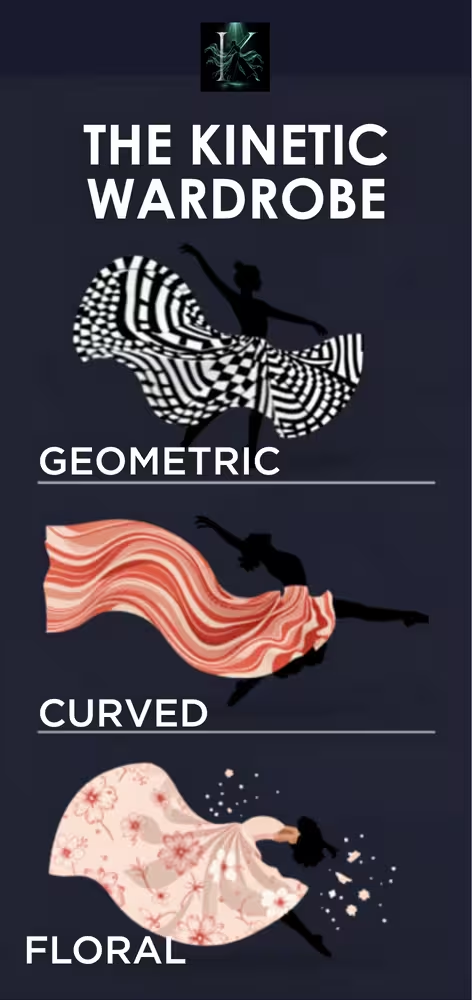
Geometric prints (checks, stripes, chevrons, polka dots, grids, and triangles) are the physicists of the pattern world. They rely on order, repetition, and precise angles. Their reaction to movement is defined by two opposing forces: anchoring (creating a sense of structure) and optical disruption (creating illusions of bending or breaking).
How Geometrics React to Movement:
- Rigidity vs. Stretch: On woven, non-stretch fabrics, geometrics remain stubbornly themselves. A grid stays a grid, even when the body curves. This creates a fascinating tension between the body’s organic form and the fabric’s mathematical insistence. On knits, geometry becomes a funhouse mirror—squares become rectangles, circles become ellipses.
- High Contrast Edge Blur: Sharp lines (like a houndstooth or a stripe) blur into a vibration when moving fast. The eye can no longer resolve the edge, creating a shimmering effect similar to a filmstrip.
Movement-Specific Reactions:
- Slow Spins (Pirouette, adagio turns): Geometry excels here. As the dancer rotates slowly, the lines act like the spokes of a wheel, reinforcing the axis of the spin. Vertical stripes emphasize elongation and centripetal force; concentric circles (like a target) draw the eye to the navel, the center of rotation. The print remains legible, becoming a hypnotic, ticking clock.
- Fast Spins (Fouetté, chaînés): Geometry becomes pure abstraction. A pinstripe suit blurs into a solid, smoky grey. Polka dots merge into streaking comets. This is the “blender effect.” The faster the rotation, the more the pattern loses its identity, becoming a field of energy. This is ideal for moments of virtuosity or psychological frenzy.
- Jumps (Grand jeté, sauté): In the air, geometry creates a freeze-frame effect. A checkered leotard, when photographed mid-leap, looks almost static—the straight lines contrast sharply with the parabolic arc of the body. The print’s structure makes the jump read as more powerful and deliberate.
- Falls (Collapse, swoon, barrel roll): Geometry fractures beautifully. A grid that was once orderly becomes a set of broken, jagged shards as the fabric crumples. Triangles turn into chaotic arrowheads. This is excellent for moments of tragedy or distortion, as the print visually “shatters” with the dancer.
- Twist (Cuban twist, torso isolations): The torsion effect is dramatic. A straight stripe running down a leg will turn into a DNA-like double helix when the dancer twists from the hips. Geometric prints announce torsion better than any other pattern, as the contrast between the original right angle and the twisted diagonal is stark and instantly readable.
- Undulations / Serpentine Waves: Geometrics fight undulation. A stiff zigzag will resist a smooth body wave, creating a staccato, robotic effect. This is why 1920s geometric dresses were perfect for the Charleston (sharp, angular) but wrong for a lyrical water dance.
Verdict: Use geometry for power, precision, speed, and psychological tension. It is the print of control and its deliberate loss.
Part 2: The Fluid Chameleon – Curved and Serpentine Lines
This family includes wavy lines, spirals, meanders, paisley’s curved teardrops, and true serpentine (S-curve) patterns. Unlike geometry’s insistence on order, curved prints are born of flow. They are the dancers of the print world, predisposed to mimic and amplify the body’s natural arcs.
How Curved Lines React to Movement:
- Liquid Synchrony: Curved lines are inherently sympathetic to the human form, which is composed of no straight lines. They stretch into longer, thinner waves or compress into tighter loops without breaking.
- The Acceleration Gradient: A serpentine line has an inherent directionality. When the body moves, the line’s curve seems to “slide” along the body’s surface, creating a sense of perpetual motion even in stillness.
Movement-Specific Reactions:
- Slow Spins: This is where serpentine prints achieve poetry. The S-curves wrap around the torso like vines. During a slow relevé turn, the lines appear to spiral inward toward the axis, then outward again. It creates a hypnotic, oceanic feeling—like watching a nautilus shell rotate.
- Fast Spins: Unlike geometry, which blurs into a uniform field, curved lines blur into coherent motion streaks. A set of parallel wavy lines, when spun fast, looks like a rotating whirlpool or a Catherine wheel firework. The pattern retains its curvilinear identity, merely becoming a faster, smoother vortex.
- Jumps: In a leap, curved lines exaggerate the body’s trajectory. A serpentine pattern running down a dancer’s side will seem to “throw” the body forward. As the dancer arcs through the air, the wavy lines visually double the parabola of the jump, making it appear longer and more liquid.
- Falls: Curved lines turn a fall into a cinematic dissolve. As the body sinks, the S-curves collapse into gentle loops and figure-eights, mimicking the recoil of a spring. There is no harsh fracture, only a graceful compression. Perfect for dramatic, romantic collapses (think Giselle’s mad scene).
- Twist: The twist is the natural home of the serpentine print. A slow, sensual torso twist will perfectly align with a paisley or meander pattern, creating a moiré effect where the fabric’s lines seem to be swimming independently of the body. The eye cannot tell where the print ends and the movement begins.
- Undulations (Body waves, cambré): Absolute harmony. When a dancer performs a vertical or horizontal body wave, a serpentine print will appear to be the cause of the movement, not a decoration on it. The wave travels through the fabric, creating an illusion of living skin. This is the ultimate match—serpentine lines and undulations are the same shape expressed in different media.
Verdict: Use curvilinear and serpentine prints for lyrical, contemporary, and romantic styles. They excel at continuous, flowing, and rotational movements. They are the prints of empathy and emotional fluidity.
Part 3: The Organic Explosion – Floral Prints
Florals are the most complex and variable category. They range from tiny, regular ditsy prints to giant, chaotic chintz blooms. Their reaction to movement is defined by scale, density, and the contrast between stem (line) and blossom (mass).
How Florals React to Movement:
- Figure-Ground Confusion: A floral is a two-layer system (leaves/stems vs. flowers). Movement causes these layers to separate perceptually. The stems (lines) might flow while the flowers (spots) remain relatively still, creating a disorienting but beautiful depth effect.
- Scale Dependency: A small, dense floral acts almost like a textured solid (similar to a pointillist painting). A large, sparse floral acts like a set of independent moving islands on the body.
Movement-Specific Reactions:
- Slow Spins: A large floral in a slow waltz turn is breathtaking. The flowers will appear to orbit around the dancer’s center. A rose on a hip will travel to the stomach, then to the ribs, then back—all due to the twisting of the fabric on the body. This creates a “mobile garden” effect, where each bloom has its own choreography.
- Fast Spins: This is dangerous territory for large florals. The flowers will blur into indistinct, colored blobs, while the stems disappear. The result can look like a chaotic splatter—unintentionally messy. However, small, dense florals (like a tiny Liberty print) blur into a beautiful, textured shimmer, like an Impressionist painting of a field.
- Jumps: Florals are at their happiest in the air. During a jump, the flowers “lift” with the dancer. The stems stretch, and the blooms seem to float slightly off the fabric’s surface. A large floral on a flying skirt creates the classic “poppy field in the wind” effect—pure joy and freedom. This is why spring-themed ballets use floral prints for allegro movements.
- Falls: A floral fall can be either tragic or chaotic. A small, regular floral will crumple into a dense, organic heap, like a pressed flower—melancholic but pretty. A giant, irregular floral will become completely illegible, turning into an abstract mess of petals and shadows. This works for extreme expressionist pieces but fails for neoclassical clarity.
- Twist: The twist creates an effect called “petal shear.” As the dancer isolates their ribcage from their hips, a flower printed across the waist will be torn into two halves—the top half moves left, the bottom half moves right. This is a powerful, almost violent visual. It works brilliantly for dramatic pas de deux or character pieces.
- Undulations: Florals undulate with a “flying petal” effect. As a body wave travels up the spine, the flowers seem to open and close, like a time-lapse film of blooming. The stems slither, the leaves flutter. This is deeply sensual and organic, perfect for pieces about nature, growth, or awakening.
Verdict: Use small florals for texture and shimmer; use large florals for narrative and emotional punctuation. They are at their best in jumps, slow turns, and undulations, but can become illegible in very fast spins or violent twists.
Part 4: Comparative Table – A Dancer’s Quick Reference
| Movement | Geometric (Stripes/Checks) | Serpentine / Curved Lines | Floral (Large/Medium) |
|---|---|---|---|
| Slow Spin | Reinforces axis, hypnotic ticking | Spiral vortex, oceanic flow | Orbiting flowers, mobile garden |
| Fast Spin | Blurs to solid/static field | Coherent whirlpool streaks | Chaotic blobs (often messy) |
| Jump | Freeze-frame power, rigid arc | Doubles the parabola, liquid hang | Floating blooms, joyful wind effect |
| Fall | Fractures into shards | Collapses into gentle loops | Crumples organically or becomes abstract |
| Twist | Creates DNA double helix | Moiré swimming effect | Petal shear (violent separation) |
| Undulation | Staccato, robotic (fights curve) | Perfect harmony, living skin | Flowers open/close, blooming effect |
Conclusion: Choreographing with Prints
To choose a print is to choose a partner in movement. A choreographer planning a piece about industrial alienation and sharp, jerky gestures will find a perfect ally in a broken geometric check. A choreographer creating a water-themed contemporary solo about grief and release will need the liquid empathy of serpentine lines. And a choreographer staging a joyous, leaping peasant dance in a spring meadow would be foolish to avoid large, exuberant florals.
The body moves; the print reacts. But the wisest designers know that the reaction is never passive. The next time you watch a dancer spin, do not look at their face or their feet. Look at the pattern on their dress. You will see a second, silent performance—a ghost dance of lines, angles, and petals, swirling in response to the laws of physics and the will of the flesh.