One Costume, Many Silhouettes: The Art of Dressing a Bellydance Fusion Ensemble
A dance company is much like a constellation.
From a distance, the audience sees a single image, a pattern of movement, light, and intention. Yet each star within that constellation shines with its own shape, its own brightness, its own character. The beauty of an ensemble does not come from making every dancer identical. It comes from weaving differences into harmony.
This is one of the most fascinating challenges in modern bellydance fusion costuming: how to create a strong collective identity while honoring the unique proportions of every dancer in the group.
In many troupes, there are dancers with pear-shaped figures, inverted triangles, hourglasses, apple shapes, and rectangular silhouettes. Expecting one costume design to flatter all of them equally is much like expecting a single melody to suit every instrument in an orchestra. The goal is not uniformity. The goal is balance.
When approached thoughtfully, small adaptations in tops, necklines, sleeves, skirts, and layers can allow every dancer to feel beautiful and confident while preserving the visual integrity of the ensemble.
The Illusion of Sameness
Many directors begin with the idea that all costumes should be exactly alike. After all, unity is important on stage.
Yet visual unity does not necessarily require identical garments.
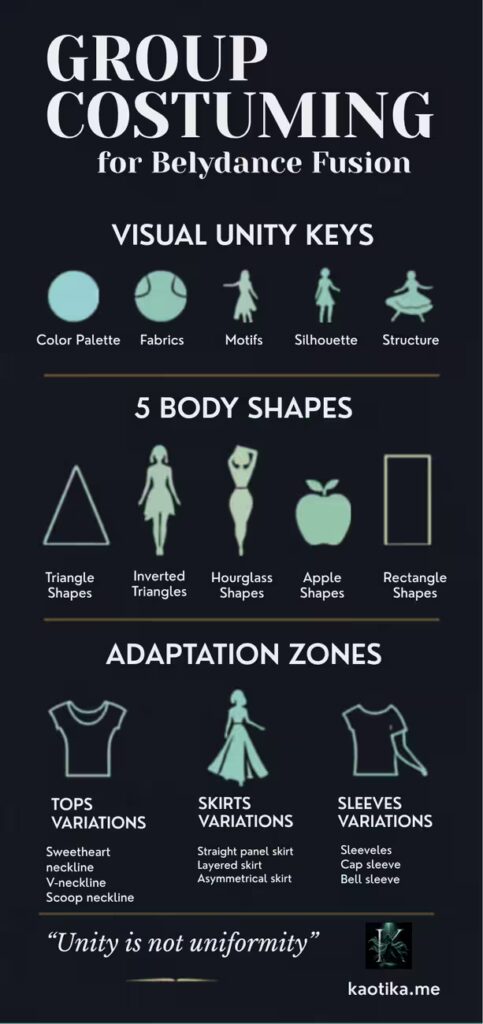
What truly creates cohesion is consistency in the elements the audience notices first:
- Color palette
- Fabric selection
- Decorative motifs
- Silhouette family
- Overall aesthetic
If all dancers wear the same jewel-toned velvet, the same antique gold embellishments, and the same fusion-inspired styling, the audience will perceive a coherent group image even if subtle adjustments exist within the costume design.
In fact, allowing these adjustments often creates a more polished result because each dancer appears comfortable and balanced.
A costume should support the dancer, not force the dancer into a shape she does not possess.
Dressing the Triangle: Creating Light Above
The triangle, or pear-shaped figure, is characterized by hips that are wider than the shoulders.
Imagine a tree whose roots are strong and grounded. The task of the costume is simply to bring a little more visual attention upward so that the silhouette feels balanced.
For these dancers, tops can become a canvas for detail:
- Embroidered shoulders
- Decorative necklines
- Draped sleeves
- Statement jewelry
- Textured fabrics near the bust
A sweetheart neckline or softly rounded neckline often works beautifully, drawing the eye toward the face.
When designing skirts, it is usually wise to avoid concentrating excessive decoration directly across the hips. Instead, details can travel vertically, allowing movement to become the focus rather than width.
The objective is not to hide the hips. Bellydance celebrates the hips. The objective is simply to create dialogue between the upper and lower body.
Dressing the Inverted Triangle: Let the Movement Fall Downward
The inverted triangle often appears athletic and powerful, with shoulders broader than the hips.
For these dancers, the costume can guide the eye downward, allowing the lower body to participate more actively in the visual composition.
Flowing skirts become valuable allies:
- Circular skirts
- Layered panels
- Ruffles
- Godets
- Draped hip scarves
A deep V-neckline can soften shoulder width, while narrow straps and clean shoulder lines help avoid additional visual volume.
Think of a waterfall. The eye should flow naturally from the shoulders toward the movement of the skirt, creating graceful balance throughout the silhouette.
Dressing the Hourglass: Preserving Natural Harmony
The hourglass silhouette already possesses a strong sense of proportion.
In many cases, the role of the costume is not to correct but to support.
Sweetheart necklines, V-necks, and softly sculpted tops often work beautifully. Fitted waistlines can emphasize the body’s natural architecture without exaggerating it.
For these dancers, restraint is often more elegant than excess.
Rather than adding volume where it is not needed, focus on enhancing the lines already present.
A well-designed costume should feel like a frame around a work of art, not a distraction from it.
Dressing the Apple Shape: Creating Flow and Verticality
Apple-shaped dancers often carry more volume through the torso while possessing beautiful legs, expressive arms, and strong stage presence.
The key here is movement.
Long lines, soft draping, and vertical details can create an elegant sense of flow throughout the body.
Particularly effective choices include:
- Moderate V-necks
- Layered panels
- Long vests
- Open-front overlays
- Soft asymmetrical drapes
Rigid horizontal divisions across the waist can interrupt visual flow, whereas layered fabrics encourage the eye to travel smoothly from shoulder to hem.
Imagine fabric behaving like water rather than architecture.
The result feels lighter, softer, and wonderfully dynamic in motion.
Dressing the Rectangle: Creating Curves Through Design
The rectangular figure often possesses an athletic beauty and clean lines.
The costume’s role is to introduce dimension and visual rhythm.
Strategic details can help:
- Draped hip scarves
- Layered skirts
- Gathered bust lines
- Curved seam placement
- Soft peplum shapes
- Asymmetrical panels
These elements create gentle suggestions of curves without appearing artificial.
The goal is not transformation. It is enhancement.
Costume design should never fight the body. It should collaborate with it.
Necklines: The Quiet Architects of Balance
One of the simplest ways to personalize a group costume is through neckline variations.
A troupe may share the same fabric, color, and decorative style while allowing dancers to choose among:
- Sweetheart necklines
- Soft V-necks
- Scoop necklines
- Gentle square necklines
Most audience members will never consciously notice these differences.
What they will notice is that every dancer appears comfortable, elegant, and confident.
And confidence is always visible.
Sleeves: The Poetry of Proportion
Sleeves do far more than cover the arms.
They influence how the entire upper body is perceived.
Bell sleeves can bring softness and volume to narrower shoulders.
Slim mesh sleeves can refine a broader upper body.
Flowing chiffon sleeves can create beautiful movement around the arms while maintaining a cohesive aesthetic throughout the group.
The secret is consistency.
The sleeve shapes may differ, but the fabric, color, and decorative language should remain the same.
Like verses within a poem, the wording changes while the rhythm remains.
Skirts: Where Individuality Meets Motion
Fusion costuming offers extraordinary freedom when it comes to skirts.
Within a single group aesthetic, dancers might wear:
- Layered skirts
- Panel skirts
- Asymmetrical skirts
- Soft mermaid silhouettes
- High-low hems
As long as the fabric family and visual language remain consistent, these variations can coexist beautifully.
This flexibility becomes particularly valuable when balancing different body shapes.
A dancer with narrower hips may benefit from additional volume.
A dancer with fuller hips may prefer cleaner lines and softer draping.
Both can exist within the same costume concept.
The audience will perceive richness rather than inconsistency.
Layers: The Secret Language of Fusion Costuming
Modern bellydance fusion has embraced layers as both an artistic and practical tool.
A layer can soften a line, lengthen a silhouette, or introduce movement without changing the costume’s core identity.
Consider:
- Lace overlays
- Chiffon drapes
- Open-front robes
- Hip panels
- Mesh shrugs
- Harness-inspired accents
Layers allow designers to customize silhouettes while preserving visual unity.
More importantly, they create depth.
And depth is often what transforms a costume from attractive to unforgettable.
Designing for the Ensemble, Not the Individual
When creating costumes for a troupe, it is helpful to think like a painter rather than a tailor.
The audience does not examine dancers one by one.
They see shapes moving together.
They see color.
They see texture.
They see energy.
The question is never, “Are these costumes identical?”
The question is, “Do these dancers belong in the same visual world?”
If the answer is yes, the costume has succeeded.
A Final Thought
The strongest dance ensembles rarely look like a row of matching mannequins.
They look alive.
They look human.
They look like a collection of distinct artists united by a shared vision.
A thoughtful costume acknowledges this truth.
It allows the dancer with broad shoulders to feel balanced, the dancer with fuller hips to feel celebrated, the dancer with a softer waistline to feel elegant, and the dancer with straighter proportions to feel expressive.
The audience may never notice the carefully chosen neckline, the adjusted sleeve, or the slightly different skirt shape.
But they will notice the result.
They will see a group that moves as one.
And within that unity, they will see every dancer shine.