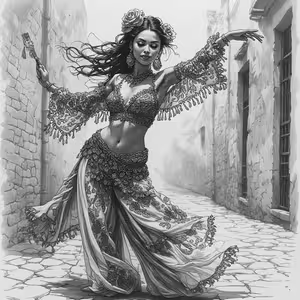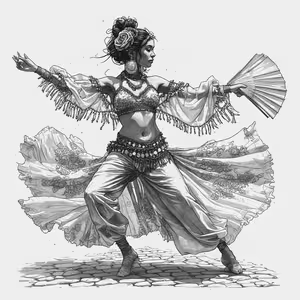
For too long, the skirt has been a silent prisoner in the wardrobe of the feminine. Yet, on a male body in motion—sweeping across a contemporary stage, spinning in a fusion of flamenco and urban flow, or dropping to the floor in a theatrical collapse—the skirt ceases to be a garment. It becomes an exoskeleton of air, a visual echo of the dancer’s own energy.
A male dance skirt is not a costume. It is a tool. A muscle. A breath. Unlike its female counterpart, which often seeks to highlight the curve of hips or the vulnerability of the exposed leg, the masculine skirt is an instrument of volume, power, and controlled chaos. It speaks in the language of vectors: where the leg goes, the fabric follows with a deliberate delay, painting the trajectory of your power in space.
Part I: The Alchemy of Fabric and Cut
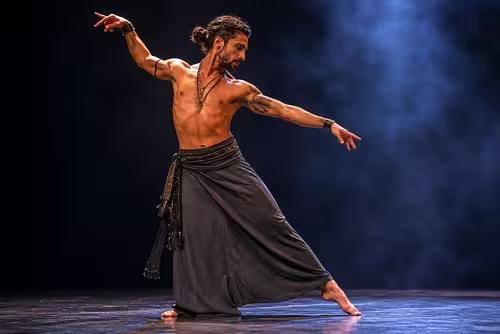
The wrong skirt will bully you. The right one will lift you.
Fabrics: The Textiles of the Wind
For the male dancer, weight is tyranny. You do not want a fabric that clings to the thigh; you want a fabric that declares its presence while remaining weightless.
- Gauze: The undisputed king of the male dance skirt. Its semi-transparency allows the muscular architecture of the leg to remain visible—a vital requirement for technique—while creating a soft, volcanic cloud around the pelvis. Double-layered soft gauze is ideal; it resists tearing during floorwork and dries instantly from sweat.
- Silk Chiffon: For lyrical and jazz. It has a metallic whisper sound. It is sharper than gauze, holding a crease or a flare for half a second longer. Excellent for quick directional changes.
- Georgette: Heavier than chiffon, but with a sandy texture that prevents slipping off the hip during fast spins. It moves like water that has suddenly decided to become solid.
- Ripstop Nylon: For experimental and Afro-fusion. It cracks like a whip. It does not float; it pops. Perfect for robotic isolations and percussive hip hits.
Cuts: The Geometry of Masculinity
The difference from a female skirt is architectural. A woman’s dance skirt often sits at the natural waist (the narrowest point) or the hips, creating an hourglass silhouette. The male skirt must respect a different geometry: the inverted triangle of the shoulders and the straight lines of the pelvis.
- Low-rise wrap skirt: Sits just below the iliac crest (the hip bones). This elongates the torso and allows the fabric to fall from the widest part of the male hip, creating a dramatic A-line.
- The Asymmetrical Panel Cut: Shorter on the right (mid-thigh), longer on the left (mid-calf). This is a warrior’s cut. It creates two different voices for the legs: one exposed for percussive footwork, one cloaked for sweeping drags.
- The Split Front (Not Side): While female skirts split on the side for leg lifts, the male dancer benefits from a front split that starts at the groin. This allows for deep plies and arabesques without emasculating the line; it frames the movement like a curtain opening on a stage.
- The Flare: Male skirts need a gathered yoke (waistband) with a flat fall. Too much gathering looks like a ballet tutu. Too little looks like a towel. Aim for a 180-degree flare—enough to catch a fast spin, not enough to float up during a drop.
Part II: The Dialogue of Movement
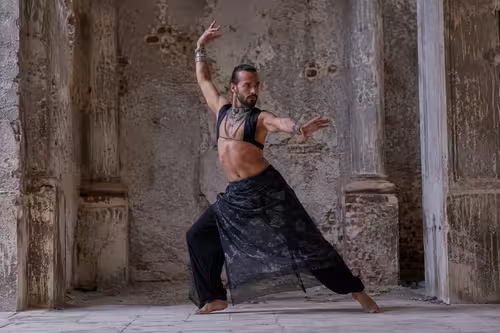
How does the skirt react? This is the heart of the matter. A male dancer does not wear the skirt; he conducts it.
Slow Turns: The gauze overskirt acts as a viscous fluid. In a slow pirouette, the fabric wraps around the legs like a second skin, then unfurls half a beat after you stop. This delay creates a ghost turn—a visual echo that doubles your power.
Fast Spins: Physics takes over. A chiffon skirt will rise horizontally, becoming a disc of smoke at your waist. The male advantage? Broader shoulders. The horizontal line of the skirt meets the horizontal line of the arms, creating a perfect T-shape—a rotor of human energy.
Falls: When you collapse to the floor, a female skirt pools gently. A male skirt explodes into a puddle. The weight of georgette or gauze cushions the impact of a knee drop, and the rising fabric during the recovery becomes a metaphor for resilience.
Jumps: The secret is to jump through the skirt, not with it. In a grand jeté, the back leg pushes the fabric forward, so you land inside a cloud. It transforms a leap from a physical action into a magical appearance.
Pirouettes: For multiple turns, a heavy skirt destroys balance. You need a silent partner skirt: a double-layer gauze overskirt worn over leggings or tight pants. The overskirt adds rotational inertia (keeping you spinning longer) while the pants provide friction for a clean landing.
Floorwork: Danger zone. Cotton and linen will twist into tourniquets around your legs. Ripstop nylon or poly-spandex blends survive. Also, technique: never land on the back of the skirt. Always tuck the excess fabric into your waistband before a floor sequence.
Micro-movements (Isolations and Layers): This is where the male skirt becomes poetic. A subtle hip slide in a gauze skirt produces a ripple that travels from left to right like a wave arriving late to shore. The fabric amplifies the micro; it makes the invisible, visible.
Camel Undulations (Oriental and Fusion): A vertical chest wave. The skirt remains still while the torso moves—this contrast is stunning. The stillness of the hem against the undulation of the spine creates a floating torso effect. For modern bellydance fusion, use a heavy georgette overskirt over loose pants; the pants articulate the legwork, the skirt articulates the pelvis.
Hip Hits and Pops: The skirt is a drum. A sharp hip drop in a parachute fabric produces a percussive snap (the fabric hitting the thigh). In a soft gauze, it produces a swish. You choose the instrument. For flamenco fusion, you need a layered skirt with a weighted hem so the hip hit produces a thwack—a percussive beat.
Hip and Pelvic Circles: The skirt becomes a vortex. A slow, large circle drags the fabric in a continuous spiral. A fast, tight circle makes the hem flutter like a hummingbird’s wings. The key is a circular cut (not A-line) for this movement.
Shimmies: The grand test. A layered gauze overskirt transforms a three-quarter shimmy into a visual shimmer—the fabric vibrates at a different frequency than the legs. For a freeze shimmy (stopping the legs, continuing the shimmy in the hips), the skirt continues to move for a full second after the legs stop. This is ghost vibration. Only a true masculine skirt (with a looser yoke) can achieve this.
Part III: The Overskirt – The Gaze of Gauze
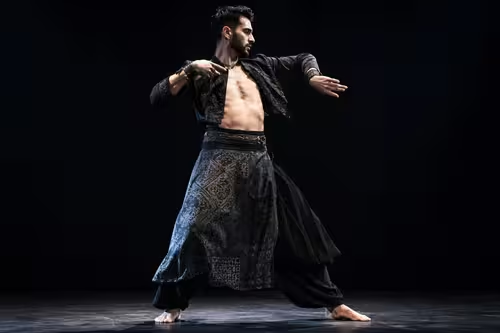
Let us speak specifically of the gauze overskirt. Worn over trousers or a long base skirt, this is the peak of masculine dance engineering.
Over trousers: It hides the knee angle (good for imperfect lines) while revealing the foot articulation (essential for tap, flamenco, and contemporary). It creates the illusion of a dress while maintaining the reality of pants.
Over a long skirt: Two layers of different lengths. The underskirt (heavy, solid) provides grounding. The overskirt (gauze, light) provides flight. During a camel undulation, the underskirt moves with the pelvis, the overskirt remains floating, detached. During a fall, the overskirt rises like smoke while the underskirt pools.
Practical advice: The overskirt must be at least six inches shorter than the base layer. It must tie with two side straps (not one central) to prevent rotation during spins. Wash it in cold water only; heat destroys the memory of the gauze.
Part IV: Genres of the Male Skirt
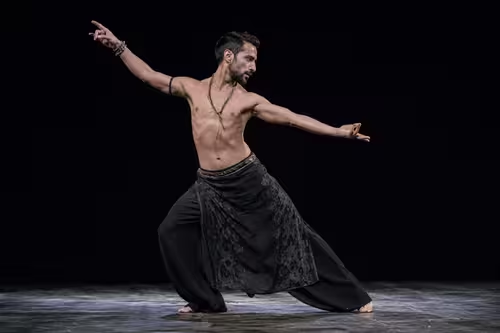
Contemporary and Experimental Dance: Here, the skirt is a prop as much as a garment. Use a deconstructed skirt (tears, raw edges, asymmetrical hems). The movement is gritty: drag it, throw it, catch it. The fabric reacts with friction.
Modern Bellydance Fusion (Tribal Fusion / Gothic): The skirt is a weapon of majesty. Heavy velvet or brocade panels over black gauze. The contrast between the weight of the fabric and the speed of the hip work creates a dark water aesthetic. Shimmies here are slow and deep.
Lyrical Jazz: Chiffon, pastels, a high-waisted fit. The skirt must fly. Every jeté is a moment of suspended animation. The male dancer in a lyrical skirt seeks vulnerability without fragility. The fabric must be tear-resistant because you will cry on it (metaphorically) during emotional falls.
Theatrical Dance (Musical Theatre and Storytelling): The skirt must be loud (sequins, stiff mesh, bold colors). It is a character. It reacts to anger (sharp turns, fabric whipping) and tenderness (slow drags, fabric pooling). Practical tip: line it with cotton to absorb sweat under stage lights.
Afro-Fusion: Ripstop or cotton drill. The skirt is percussive. Every hit of the pelvis produces a slap of fabric. The cut is short (above the knee) to allow for polyrhythmic footwork. The skirt here is not air; it is a second heartbeat.
Flamenco Fusion: The long trained skirt for men, but modified. A heavy georgette skirt with a weighted hem (a thin metal chain sewn inside the edge). The stomp makes the hem jump. The marking step makes it drag. The male flamenco skirt never twirls fully; it swings like a bell. The power comes from the heel strike transmitted through the fabric.
Epilogue: The Dance of the Unspoken
A final, practical, poetic truth. The male dance skirt is not a transgression. It is a return. For centuries, men wore skirts (kilts, sarongs, fustanellas) to fight, to hunt, to worship. The dance skirt is simply a memory of that freedom.
When you put it on, forget femininity. Forget masculinity. Listen only to the fabric. During a slow turn, it will whisper. During a drop, it will roar. During a shimmy, it will laugh. Your job is not to wear it, but to let it wear your movement.
Choose your gauze like you choose a partner: with trust. Cut your asymmetry like you cut your path: with intention. And when you step onto that stage—whether in a dark theatre or a sun-drenched studio.
Let the fabric speak.