
A room is usually designed to be lived in. A stage is designed to be seen.
At first, these two worlds might seem far apart. One deals with homes, hotels, restaurants and everyday spaces; the other with performances, costumes, lighting and temporary worlds that may exist for only a few hours.
Yet stage design has something valuable to teach interior designers: a space is not only a composition of objects. It is an experience that unfolds over time.
Walk into a beautifully designed room and you may notice its colours, furniture and materials. Watch a stage come alive and something else happens. Light changes. Shadows move. A performer enters. A fabric catches the light. The space suddenly feels larger, closer, colder, warmer, more mysterious.
The room has become a scene.
And this is where stage design becomes surprisingly useful for interior design.
1. Think about the scene, not just the room
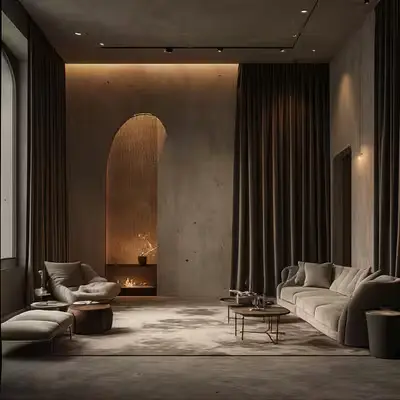
Interior design often begins with a practical question:
What should go in this room?
Stage design begins somewhere slightly different:
What should happen here?
That small change in perspective can completely alter the way a space is designed.
Instead of starting with a sofa, a dining table or a beautiful pendant lamp, imagine the room as a sequence of moments.
Where does someone enter?
What do they notice first?
Where does their eye travel next?
Where might they stop?
What should feel intimate, dramatic, calm or unexpected?
This is one of the most interesting lessons of stage design for interior designers. A successful space does not necessarily reveal everything at once.
Sometimes, anticipation is part of the design.
A partially hidden view through a doorway. A corridor that gradually reveals another room. A pool of light falling onto a particular chair. A painting that becomes visible only from a certain angle.
The space tells its story in stages.
2. Lighting is not decoration
This may be one of the most important lessons stage design can offer interior designers.
In a conventional interior, lighting is sometimes treated as the final layer: something that illuminates the furniture once everything else has been selected.
On stage, lighting can completely transform the meaning of the same physical environment.
A wall can appear warm or cold. A surface can become dramatic or almost invisible. Texture can suddenly emerge. A simple curtain can become an architectural element.
The objects have not changed.
The way we perceive them has.
Interior designers can borrow this idea by thinking about lighting as a visual editing tool.
Not every element needs equal attention.
A room can have areas that speak loudly and others that remain quiet. A directional light can create a visual pause. A softer light can make a material feel tactile rather than merely visible.
And natural light can be treated in the same way.
Morning light, afternoon light and artificial light do not create the same room.
Perhaps the most interesting question is therefore not Which light fixture should I use?
It is:
How should this room feel at 8 a.m., at 4 p.m. and after dark?
3. Design for movement
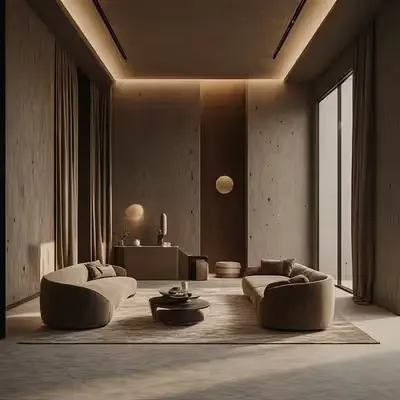
A stage is rarely static.
Performers cross it. Costumes move through it. Light travels across surfaces. Curtains open and close. Shadows shift.
Interior spaces move differently, but people still move through them.
We enter, sit, stand, turn, look out of a window, walk towards another room and discover different perspectives.
This means that a good interior can be considered almost like choreography.
The position of a chair can influence where someone looks.
The width of a passage can change the rhythm of movement.
A low piece of furniture can preserve a visual connection between two spaces.
A curtain can conceal something for a moment and then reveal it.
Even a reflective surface can create movement because the image changes as we move around it.
This is where stage design and interior design quietly meet.
Space is experienced from multiple positions, not from a single photograph.
4. Create focal points with intention
Stage designers know exactly where they want the audience to look.
Interior designers have the same responsibility, although the audience is usually unaware of it.
A fireplace, artwork, sculptural staircase, window, architectural detail or unusual piece of furniture can become the visual protagonist of a room.
But a focal point becomes less effective when everything around it is competing for attention.
This is another lesson from the stage:
Contrast creates hierarchy.
A dramatic object can become more powerful when surrounded by quieter elements.
A richly textured wall may need simpler furniture.
A spectacular piece of art may benefit from visual breathing space.
A sculptural lamp can become more expressive when the surrounding lighting is restrained.
The goal is not to make every element impressive.
The goal is to decide which element deserves the first look.
5. Use colour as atmosphere
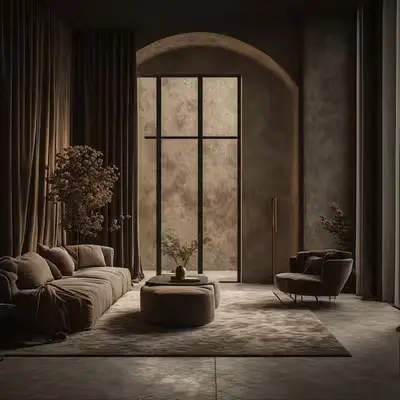
Stage designers rarely choose colour simply because a colour is beautiful.
Colour can establish a mood, separate worlds, suggest a particular time or alter the emotional temperature of a scene.
Interior designers can use colour in a similar way.
A deep blue does not automatically create a sophisticated interior. A red room is not automatically dramatic. Green does not always mean natural or relaxing.
Colour changes depending on what surrounds it, how much of it is used and, importantly, how it is illuminated.
A velvet surface and a matte wall may share the same colour but respond to light very differently.
This is particularly important in interiors photographed for magazines, websites and social media.
A room that looks balanced in daylight may become completely different under artificial lighting.
Colour is not static.
It is part of the atmosphere.
6. Materials have a performance
This is perhaps one of the most overlooked connections between stage and interior design.
Materials do not simply have a colour and texture. They have behaviour.
Velvet absorbs and catches light differently from silk.
Glass reflects.
Metal can produce sharp highlights.
Matte surfaces tend to soften reflections.
Sheer fabrics can reveal silhouettes, shadows and layers behind them.
On stage, these characteristics are deliberately exploited because materials need to perform under changing light and movement.
Interior designers can think about materials in exactly the same way.
Instead of asking only:
Does this fabric look good?
Ask:
What will this fabric do when the light changes?
Will it absorb the light or reflect it?
Will its texture become more visible at an angle?
Will it create shadows?
Will it move with air?
Will it look different in a photograph?
These questions can turn material selection into something much more interesting than matching colours and finishes.
7. Leave room for mystery
Not everything has to be immediately visible.
Stage design often uses darkness, partial views, silhouettes and concealed elements to create anticipation.
Interior design can use the same principle without becoming theatrical in an obvious way.
A doorway can frame another space.
A translucent curtain can soften a view.
A shadow can conceal part of an architectural feature.
A narrow opening can suggest that there is something beyond it.
This does not mean that every interior needs to become mysterious or dramatic.
It simply means that visual information can be controlled.
Sometimes what we cannot see immediately is what makes us want to look again.
8. Design for photographs — but don’t design only for photographs
There is another lesson worth borrowing from stage design: the importance of the viewpoint.
A stage is designed to be perceived from an audience.
An interior is experienced from many different positions, but it is also increasingly photographed and filmed.
This creates a curious situation.
A room may look spectacular in a single photograph while feeling uncomfortable or uninteresting in reality.
The opposite can also happen.
A subtle interior may not produce an instantly dramatic photograph, yet feel wonderful when experienced in person.
The best interiors can do both.
They have a strong visual identity from particular viewpoints while remaining coherent as people move through them.
Think of the photograph as one frame from a larger sequence, rather than the entire story.
9. Build atmosphere, not just style
Perhaps the biggest lesson of all is this:
Stage design is rarely about style alone.
A set may be minimalist, gothic, futuristic, classical or industrial. But its style is only one part of its effect.
What matters is what the audience feels when all the elements work together.
Interior design can sometimes become too focused on labels.
Japandi. Art Deco. Minimalist. Mediterranean. Contemporary.
These words can be useful, but they do not explain the experience of a room.
Two interiors can share exactly the same style and feel completely different.
One can feel still and contemplative.
Another can feel theatrical.
Another can feel intimate.
Another can feel slightly unsettling.
The difference may come from light, scale, texture, sound, colour, movement and the relationship between visible and hidden elements.
In other words:
Style tells us what a room looks like. Atmosphere tells us what it feels like.
What happens when interior design starts thinking like stage design?
The most interesting interiors are not necessarily the ones with the most remarkable furniture.
They are the ones where the elements seem to understand one another.
Light reveals a texture.
A texture changes the way colour is perceived.
A piece of furniture directs movement.
Movement changes the viewpoint.
The viewpoint reveals another layer of the room.
Suddenly, the interior is no longer a collection of objects.
It has a rhythm.
It has pauses.
It has a beginning, a middle and perhaps even a small surprise.
That is what stage design can teach interior designers.
Don’t only design the space. Design the way the space is experienced.
Because a room, like a stage, is never exactly the same twice.
The light changes.
People move.
Shadows appear and disappear.
Materials respond.
And for a brief moment, everything comes together.
That moment is atmosphere.