
A piece of fabric can divide a room without becoming a wall.
It can create a ceiling without being a roof. It can guide movement, frame a view, soften a boundary, absorb light, reflect it, or make a space feel larger than it actually is.
At that point, something interesting happens.
The fabric is no longer simply decorating architecture.
It is beginning to behave like architecture.
This is one of the most fascinating qualities of textiles: their ability to occupy space without necessarily becoming rigid. Unlike stone, concrete or timber, fabric can remain fluid while still defining volume.
And perhaps that is why textiles have always had such a powerful relationship with interiors, theatre and temporary spaces.
They do not simply cover surfaces.
They can create the surfaces themselves.
What happens when fabric becomes architecture?
Architecture is often understood through structure: walls, floors, ceilings, openings and thresholds.
But these are not the only things that define a space.
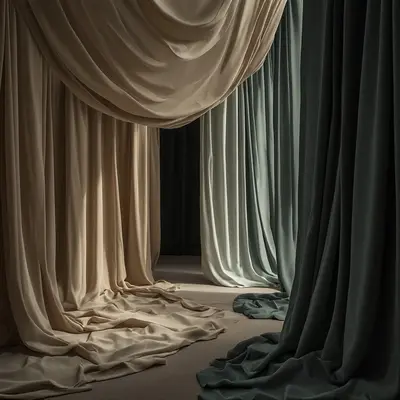
A curtain can create a threshold.
A suspended textile can establish a ceiling.
A translucent screen can separate two areas while allowing light to pass between them.
A large piece of fabric can create a temporary room inside a much larger one.
The material has not changed into stone or wood. It remains fabric.
What changes is its role.
Instead of being an object placed inside a space, the textile begins to organise the space around it.
This distinction is important.
A velvet curtain hanging beside a window is decoration.
A curtain used to divide a room, control visibility and create a transition between two environments is performing an architectural function.
The material is doing more than adding colour or texture.
It is shaping how the space is experienced.
Fabric can create boundaries without closing a space
One of the most useful architectural qualities of fabric is its ability to create separation without completely blocking what lies beyond it.
A solid wall says: here ends one space, and another begins.
A translucent textile is more ambiguous.
You can see light through it. You may perceive silhouettes. You can sense movement on the other side.
The boundary exists, but it remains visually open.
This is particularly powerful when working with sheer fabrics such as chiffon, voile or fine gauze.
Their physical presence is undeniable, but their visual presence is incomplete.
They occupy space while allowing space to remain visible.
That tension can be more interesting than a conventional partition.
It also changes with light.
During the day, a translucent textile may appear almost weightless. At night, with illumination placed behind it, the same material can become a luminous surface.
The architecture has not moved.
But the perceived architecture has changed.
Volume can come from softness
We tend to associate architectural volume with hard materials.
A wall has volume. A column has volume. A staircase has volume.
Fabric can have volume too, but it produces it differently.
Pleats, gathers, folds, tension and draping transform a flat textile into a three-dimensional object.
A curtain can become a sculptural wall.
A suspended fabric can form a canopy.
A series of hanging panels can create a corridor.
A stretched textile can produce a geometric plane.
The interesting part is that these forms are never completely fixed.
They respond to gravity.
They respond to air.
They respond to movement.
And sometimes, they respond to the people moving around them.
This gives textile architecture a quality that rigid architecture rarely possesses: instability.
Not instability in the sense of weakness, but in the sense of constant possibility.
The form can change.
The architecture of the fold
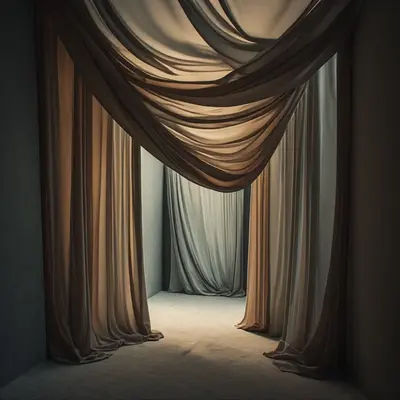
A fold is not merely a decorative detail.
It is a spatial decision.
A flat piece of fabric occupies very little visual space. Introduce a fold and suddenly the material creates depth.
Introduce hundreds of folds and the textile becomes almost architectural.
Pleating can create rhythm.
Gathering can concentrate volume.
Deep folds can create shadows.
Large, irregular drapes can produce a more organic spatial effect.
The same fabric can therefore produce completely different architectural impressions depending on how it is manipulated.
This is where material and construction become inseparable.
A lightweight chiffon gathered tightly at the top behaves very differently from the same fabric stretched between two points.
The fibre has not changed.
The relationship between fabric, gravity and tension has.
Light reveals the architecture of fabric
Perhaps nowhere is the architectural potential of textiles more visible than under light.
Fabric does not simply receive light.
It transforms it.
A translucent textile can diffuse a hard source.
A velvet surface can absorb much of the light that reaches it.
A metallic textile can redirect highlights.
A loosely woven fabric can allow points of light to pass through its structure.
And folds create their own small architecture of light and shadow.
This is particularly relevant to stage design.
On a stage, a piece of fabric may be almost invisible under one lighting state and become the dominant architectural element under another.
A curtain illuminated from the front reads as a surface.
The same curtain illuminated from behind can become a glowing plane.
A dark fabric may disappear into the background.
A reflective textile may suddenly catch a narrow beam and draw the eye across the entire stage.
The material is the same.
The architecture of the scene has changed because the light has changed.
Fabric can control movement
Architecture does not only tell us where we are.
It also influences where we go.
Doors, corridors, stairs and openings create sequences of movement.
Textiles can do something similar.
A curtain placed across an entrance creates hesitation.
A narrow passage formed by hanging fabric changes the speed at which someone moves.
A series of suspended panels can create a rhythm of openings and closures.
A long textile installation can guide the eye before the body follows.
This is particularly evident in theatre, where fabric is often used to control revelation.
You do not see everything at once.
You move.
The fabric opens.
Something appears.
The fabric closes again.
The textile becomes part of the choreography of space.
It does not simply occupy the stage.
It controls what the audience is allowed to see.
The difference between a textile object and textile architecture
The distinction can be subtle.
A beautiful upholstered chair is a textile object.
A fabric lampshade is a textile object.
A decorative cushion is a textile object.
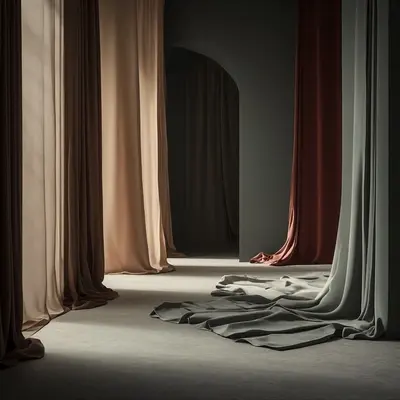
But a textile that defines a room, establishes a boundary, controls circulation or changes the perception of scale begins to operate differently.
It becomes spatial.
This does not mean that every large piece of fabric is architectural.
Scale alone is not enough.
The important question is:
What is the fabric doing to the space?
Is it merely adding colour?
Or is it changing the way the space is divided, perceived, illuminated or navigated?
That question can be useful for interior designers, set designers and stylists alike.
Scale changes everything
A small textile can be intimate.
A large textile can become environmental.
Think about the difference between holding a square of velvet in your hand and standing beneath hundreds of metres of suspended fabric.
The material is identical.
The experience is not.
Scale changes the relationship between the body and the textile.
At a certain point, the viewer stops looking at the fabric as an object and starts experiencing it as an environment.
This is one reason monumental curtains, fabric installations and suspended textiles can be so powerful.
They operate at the scale of the body.
You do not simply look at them.
You stand inside their visual field.
Why textiles are so effective in temporary architecture
There is another quality that makes fabric particularly interesting: it can create architecture without permanently altering the building.
A room can be transformed for an evening.
A gallery can become a theatre.
An open hall can become a series of intimate spaces.
A stage can become a palace, a corridor, a tent, a shadowy interior or something that does not belong to any recognisable place at all.
Then the fabric comes down.
The architecture disappears.
This temporary quality is one of textiles’ greatest strengths.
They allow space to remain flexible.
Instead of asking architecture to provide one permanent solution, fabric can provide several temporary ones.
When does decoration become space?
Perhaps this is the more interesting question.
At what point does a curtain stop being a curtain?
At what point does a textile stop being an accessory and become part of the architecture?
There is no single answer.
It may happen through scale.
Through movement.
Through light.
Through repetition.
Through placement.
Or simply through the way the material changes our perception of the room.
A fabric can be physically soft and architecturally strong.
It can be transparent and still create a boundary.
It can move and still define a space.
It can be temporary and still completely transform an environment.
That is what makes textile architecture so compelling.
The material does not need to become rigid to become structural.
Sometimes, it only needs to change the way we understand the space around it.
Fabric as an architecture of atmosphere
This is where textiles become particularly interesting for stage design and interior styling.
Architecture gives us the physical framework.
Fabric can give that framework an atmosphere.
A sheer curtain can make a room feel distant.
Heavy velvet can make it feel enclosed.
A suspended canopy can lower the perceived height of a space.
A reflective textile can introduce movement through light.
A rough woven material can make an environment feel more tactile and grounded.
None of these effects requires the fabric to become a conventional architectural element.
It simply needs to interact with space, light and the human body.
Perhaps this is the real architectural potential of fabric.
Not that it can imitate a wall.
But that it can make us question what a wall actually does.
It separates.
It frames.
It conceals.
It reveals.
It directs.
It creates atmosphere.
And fabric can do all of these things while remaining soft enough to move.
That is a very different kind of architecture.
And sometimes, the most memorable spaces begin with something that was never meant to be a wall at all.
Final thought
When fabric becomes architecture, it does not stop being fabric.
That is precisely the point.
Its softness, transparency, movement and response to light are not limitations to overcome. They are the qualities that allow it to create another kind of space — one that can be temporary, shifting and atmospheric.
A wall tells us where a space ends.
Fabric can make us wonder whether it has ended at all.