
Curtains do more than cover a window.
They filter daylight, soften sound, frame a view and change the way a room moves. A fabric can make sunlight feel warm and diffuse, turn it into a sharper glow, or almost disappear when backlit. Some curtains fall in quiet, vertical folds. Others billow, ripple or hold a sculptural shape.
This is why choosing curtain fabrics is not simply a question of colour or style.
The same colour can look completely different in linen, velvet, polyester or silk. And two fabrics with a similar appearance can behave very differently once daylight, artificial light and movement enter the room.
So what should you look for when choosing fabric for curtains?
The answer begins with four things: light, weight, movement and finish.
Why Curtain Fabric Matters More Than You Think
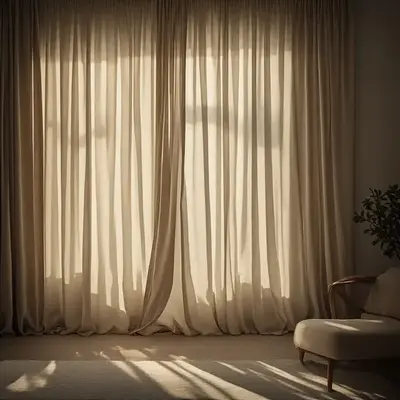
A curtain occupies a surprisingly large visual area.
Even when it is open, it remains part of the room’s composition. When it is closed, it can become one of the largest surfaces in the space.
Its texture affects how light is reflected. Its weight determines how it hangs. Its flexibility controls how it moves. Its finish can make the same fibre look matte, luminous, crisp or luxurious.
Think of curtain fabric as part of the room’s atmosphere rather than simply its decoration.
A useful question is not:
Which fabric looks beautiful?
It is:
What do I want the fabric to do with light and movement in this particular space?
That small change in perspective makes the choice much easier.
The Main Curtain Fabrics
There is no universally “best” curtain fabric. Each material creates a different combination of opacity, texture, weight, movement and light response.
Here are some of the most commonly used options.
Linen
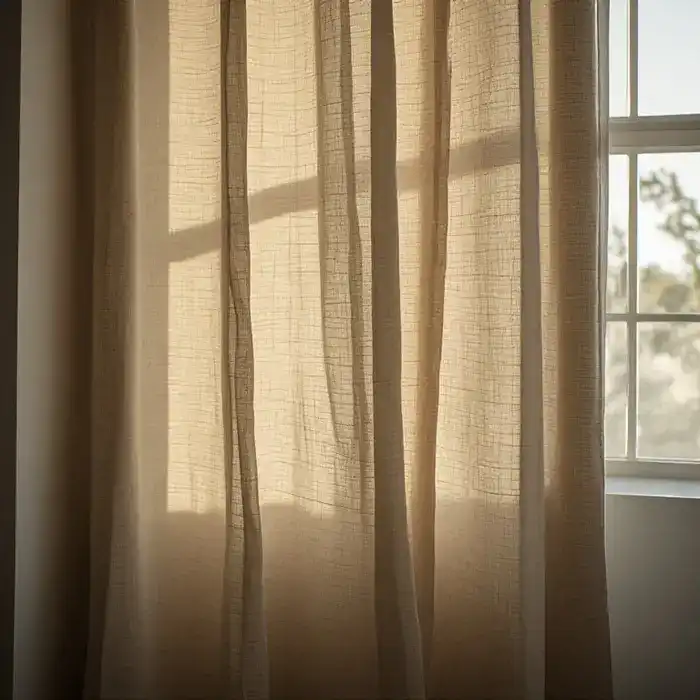
Linen is valued for its natural texture and relaxed appearance.
It usually has a matte surface, so it does not produce strong highlights when daylight moves across it. Instead, light tends to reveal the irregularities of the weave.
This gives linen curtains a soft, natural appearance.
Lighter linen or linen-look fabrics can allow considerable daylight through, while heavier versions provide more privacy and visual weight.
How linen behaves with light
Backlit linen can be particularly beautiful. Instead of becoming completely transparent, the fabric often turns into a softly illuminated surface, with the weave becoming more visible.
Direct sunlight can emphasise its texture and natural irregularities.
How linen moves
Linen generally has a relaxed fall. Depending on its weight, it can create anything from loose, casual folds to more substantial vertical pleats.
It tends to move naturally rather than dramatically.
Best suited to
- Relaxed interiors
- Coastal and natural schemes
- Contemporary spaces
- Bedrooms and living areas
- Hotels and hospitality interiors where a natural appearance is desirable
One practical consideration: linen can wrinkle more easily than many synthetic fabrics. That is not necessarily a disadvantage. In the right interior, the irregularity is part of its visual character.
Cotton
Cotton is versatile, familiar and available in an enormous range of weights and finishes.
A lightweight cotton curtain can feel fresh and informal, while a tightly woven or heavier cotton can create considerably more privacy.
Its appearance depends strongly on the weave and treatment.
How cotton behaves with light
Light cottons can create a soft glow when illuminated from behind. Heavier cottons absorb and diffuse more light, producing a quieter surface.
Because cotton is generally less reflective than highly polished synthetic fabrics, its colour tends to remain relatively stable under changing light.
How cotton moves
Lightweight cotton can move easily in an open window or gentle airflow. Heavy cotton moves more slowly and tends to create fuller, more stable folds.
This makes weight particularly important when choosing cotton for curtains.
Velvet
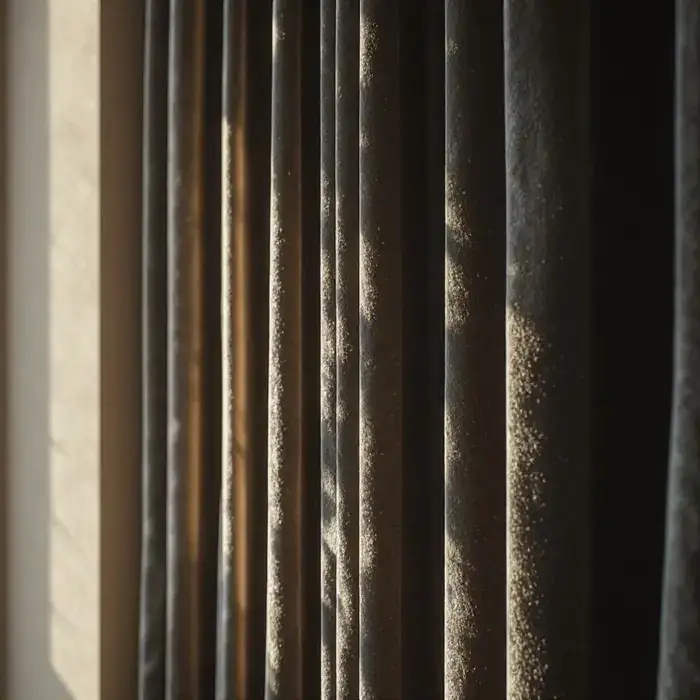
Velvet behaves very differently from linen or cotton.
Its surface has a directional pile, which means that light does not simply bounce evenly from the fabric. Instead, it catches the pile differently depending on the angle.
The result can be remarkably atmospheric.
A velvet curtain may appear lighter in one area and considerably darker a few centimetres away.
How velvet behaves with light
This is one of velvet’s defining qualities.
Side lighting can create subtle variations across the surface. Direct light can reveal the direction of the pile, while low or theatrical lighting can produce deep shadows and rich highlights.
This makes velvet particularly interesting in spaces where artificial lighting is important.
How velvet moves
Velvet is usually heavier than lightweight curtain fabrics.
It tends to fall in substantial folds rather than fluttering freely. When drawn open or closed, the folds can create a strong vertical rhythm.
The movement is slow and visually weighted.
Best suited to
- Formal interiors
- Bedrooms
- Theatrical or dramatic spaces
- Boutique hospitality
- Rooms where acoustic softness is useful
Velvet does not have to mean traditional or ornate. A simple contemporary curtain in a deep or muted colour can make the fabric itself the main visual element.
Silk
Silk has a naturally luminous quality that comes from the structure and surface of the fibre.
It can reflect light more noticeably than linen or cotton, giving curtains a delicate glow.
However, silk requires more consideration than many everyday curtain fabrics because prolonged exposure to strong sunlight can damage the fibre.
How silk behaves with light
Silk responds beautifully to changing light.
Morning, afternoon and artificial light can produce noticeably different effects because the surface reflects light rather than simply absorbing it.
A silk curtain can therefore appear almost alive as daylight changes.
How silk moves
Light silk can move easily and create fluid, elegant folds.
It is particularly expressive when air moves through the room.
The movement is less architectural than that of a heavy fabric and more fluid.
Practical consideration
For areas exposed to strong sunlight, check the fabric’s suitability and consider lining or protective treatments.
Polyester and Synthetic Blends
Synthetic fabrics are widely used for curtains because they can offer durability, consistent appearance and relatively easy maintenance.
Polyester can also be engineered to imitate the appearance of natural fibres.
It is therefore worth looking beyond the fibre name and examining the actual fabric.
How polyester behaves with light
A matte polyester can behave similarly to a natural-looking fabric, while a more polished surface can reflect noticeably more light.
Some synthetic fabrics are designed specifically for light control, including blackout curtains and dim-out fabrics.
How polyester moves
Movement depends largely on weight and construction.
Light polyester can be fluid and responsive to air movement. Heavier versions can create regular, stable folds.
This makes synthetic fabrics particularly useful when consistent performance is more important than a visibly natural texture.
Sheer and Voile Fabrics
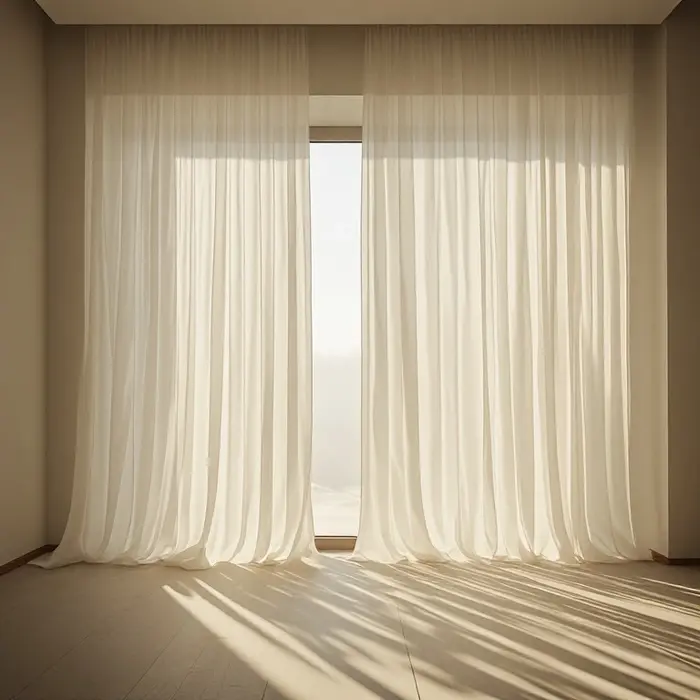
Sheer fabrics deserve their own category because their main purpose is often to transform light rather than block it.
Voile, sheer polyester, lightweight cotton and other translucent fabrics can create privacy while maintaining a connection with daylight.
How sheer fabrics behave with light
This is where they become especially interesting.
A sheer curtain can act almost like a light filter.
Instead of seeing a hard rectangle of sunlight, the room may receive a broader, softer glow.
Backlighting can make the fabric almost disappear while simultaneously making its texture visible.
This effect is particularly useful in interiors where daylight is an important part of the atmosphere.
How sheer fabrics move
Because they are light, sheers respond easily to air movement.
A slightly open window can transform a static curtain into a moving surface.
The movement can be subtle: a gentle swelling, a soft ripple, a temporary change in silhouette.
For this reason, sheer curtains can add movement to an otherwise still interior without introducing another decorative object.
Blackout and Dim-Out Fabrics
Blackout fabrics are designed primarily for light control.
They are useful in bedrooms, media rooms, hospitality spaces and any environment where controlling daylight is essential.
But “blackout” does not automatically mean visually heavy.
Modern blackout fabrics are available in different colours, textures and constructions.
How blackout fabrics behave with light
The most important characteristic is what happens when the fabric is backlit.
A conventional curtain may glow around the window.
A blackout curtain largely stops that visual effect.
This can be useful when you need a darker room, but it also changes the atmosphere dramatically. The window becomes a more solid visual element rather than a luminous one.
A useful layering solution
Instead of asking one curtain to do everything, consider layering:
sheer + decorative curtain + blackout lining
This allows the room to have different lighting conditions throughout the day.
For example:
- Sheer fabric during bright daylight
- Decorative curtains for visual framing
- Blackout lining when strong light needs to be reduced
This approach is particularly useful in bedrooms and hospitality interiors.
The Fabric Finish Can Change Everything
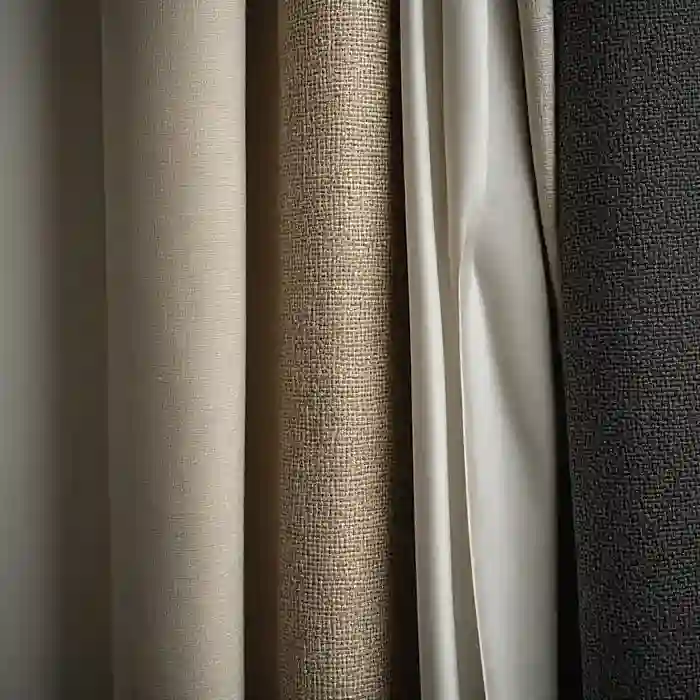
The fibre is only part of the story.
Two curtains made from the same basic fibre can look completely different because of their finish.
A finish can alter the surface, texture, sheen, stiffness, drape, opacity or resistance of the fabric.
This is why choosing “linen” or “polyester” alone is rarely enough information.
Matte finishes
Matte fabrics absorb and diffuse light rather than producing strong reflections.
They tend to look calm and stable.
They are useful when you want the curtain to support the room without becoming a luminous focal point.
Satin and glossy finishes
Glossy surfaces reflect light more directly.
Depending on the weave and angle, they can create highlights that move across the curtain.
This can add sophistication, but it can also make imperfections, wrinkles or uneven lighting more visible.
Use gloss intentionally.
A highly reflective curtain in a room already containing polished surfaces, mirrors and strong lighting may create a very different atmosphere from the same colour in a matte fabric.
Brushed finishes
Brushing raises or softens the surface fibres, creating a more tactile appearance.
The result is usually softer visually and less reflective.
It can make a fabric feel warmer without necessarily making the colour darker.
Embossed or textured finishes
Texture creates small changes in how light reaches the surface.
A plain curtain may read as one continuous colour.
A textured curtain contains hundreds of tiny variations.
When light moves across it, those variations become visible.
This can be particularly effective when the curtain is large and the colour is relatively restrained.
Treatments: When the Fabric Is Designed to Do More
Curtain fabrics can also receive treatments that change their performance.
These should be considered separately from decorative finishes.
Common treatments include:
- Blackout coatings
- Flame-retardant treatments
- Stain-resistant treatments
- Water-repellent treatments
- Anti-static treatments
- Wrinkle-resistant finishes
- Thermal or insulating treatments
- Acoustic treatments
The exact performance depends on the manufacturer and construction, so always check the technical specification rather than assuming that a fabric labelled “blackout”, “acoustic” or “fire resistant” will perform to a particular standard.
This is especially important for hospitality, commercial and public interiors, where local regulations may apply.
How Light Changes Different Curtain Fabrics
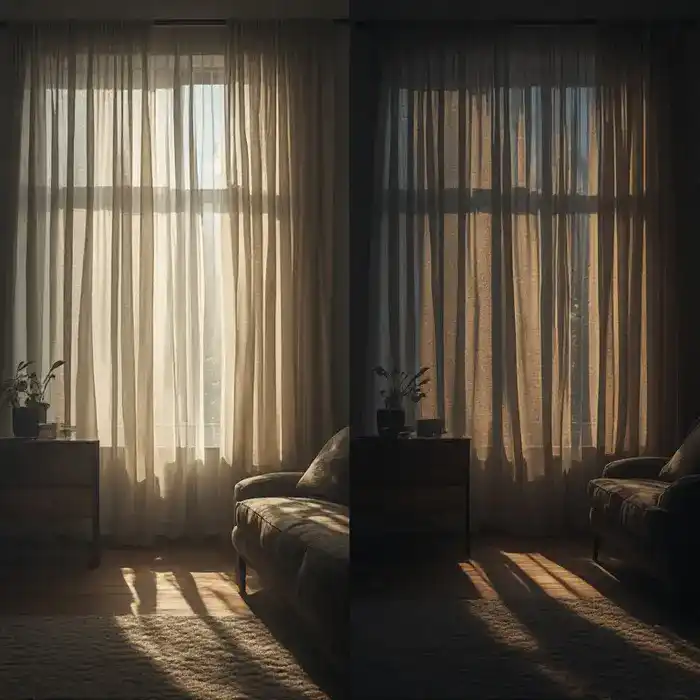
One of the easiest ways to understand curtain fabric is to imagine the same fabric in three lighting conditions.
Direct daylight
Direct sunlight reveals texture and surface variation.
Glossy fabrics can produce stronger highlights.
Textured and matte fabrics tend to diffuse the light.
Dark colours may absorb much of the available light, while pale fabrics can reflect it back into the room.
Backlighting
Backlighting is particularly revealing.
Place a curtain between the light source and the observer and its transparency becomes immediately apparent.
A sheer fabric glows.
A lightweight natural fabric becomes softly illuminated.
A dense fabric becomes more opaque.
A blackout fabric becomes almost architectural.
This is why fabric samples should ideally be tested against a window, not only under showroom lighting.
Artificial light
Artificial light can reveal completely different qualities.
Warm light can emphasise the richness of some fabrics and colours.
Directional light can create shadows in textured surfaces.
Side lighting can reveal the pile of velvet.
A glossy fabric can produce visible highlights.
If curtains are being designed for a hotel, restaurant, showroom or event space, test the fabric under the actual lighting conditions whenever possible.
The curtain will not experience the room as a fabric sample on a desk does.
Movement: The Part We Often Forget
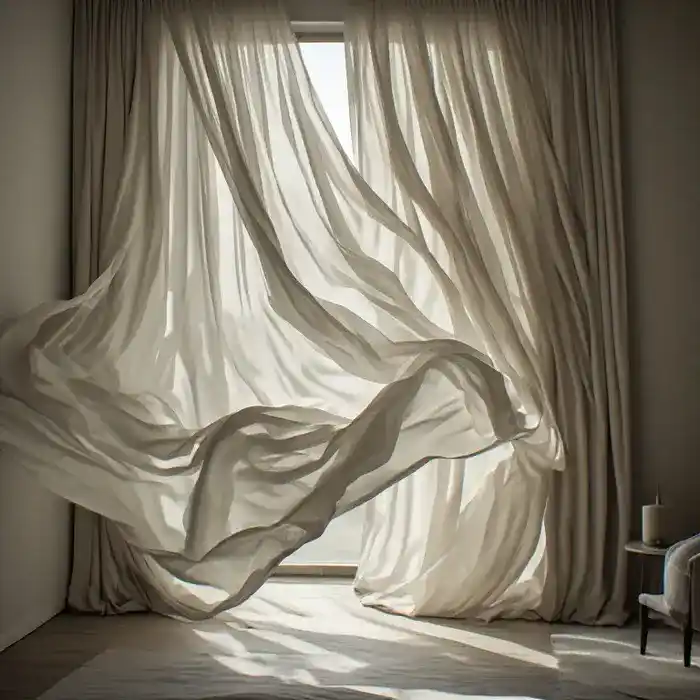
A curtain is not a painting.
It moves.
Even when the window is closed, someone opens or closes the curtain. People walk past it. Air-conditioning creates movement. An open window changes it again.
This makes drape one of the most important characteristics of curtain fabric.
A light fabric responds quickly.
A medium-weight fabric creates controlled movement.
A heavy fabric moves slowly and maintains its shape.
There is no universally correct choice.
The question is what kind of movement belongs in the room.
Light and fluid
Choose lighter fabrics when you want:
- Gentle movement
- Soft folds
- A relaxed atmosphere
- Strong interaction with air
- A sense of lightness
Structured and controlled
Choose medium-weight fabrics when you want:
- Regular folds
- A more polished appearance
- Moderate movement
- Easier visual control
Heavy and dramatic
Choose heavier fabrics when you want:
- Deep folds
- Strong vertical lines
- Slow movement
- Visual weight
- A more enclosed atmosphere
Movement becomes particularly noticeable in hospitality interiors, where curtains may be seen from a distance and experienced repeatedly throughout the day.
Don’t Choose Curtain Fabric From a Small Swatch Alone
A small fabric sample tells you something.
It does not tell you everything.
A 10-centimetre square cannot show you how a fabric behaves when it is two or three metres high.
Before making a final decision, test the fabric for:
Light:
Hold it against a window at different times of day.
Opacity:
Look at what can be seen through it from both sides.
Drape:
Hang a generous piece vertically rather than simply laying the sample flat.
Movement:
Allow air to move around it. Notice how quickly it responds and how long the folds remain in motion.
Colour:
Check it in daylight and artificial light.
Texture:
Look at it from close range and from across the room.
Finish:
Move around it. A glossy or directional surface can change significantly depending on viewing angle.
This simple test can prevent an expensive mistake.
A Practical Way to Choose Curtain Fabric
If you are selecting fabric for a project, start with the room rather than the catalogue.
Ask these questions:
1. How much daylight should enter?
If the answer is “as much as possible”, consider sheers or lightweight fabrics.
If the room needs strong light control, consider dense fabrics, lining or blackout construction.
2. Do you need privacy?
A sheer may be beautiful during the day but provide little privacy at night when the interior is illuminated.
Consider how the room works after sunset.
3. Should the curtain move?
For visible movement, lighter fabrics usually respond more readily to airflow.
For a strong architectural appearance, choose a fabric with enough weight to hold defined folds.
4. Should it absorb or reflect light?
Matte surfaces tend to diffuse.
Glossy surfaces tend to reflect.
Textured surfaces create many small variations.
5. What should the curtain feel like from a distance?
This matters especially in large rooms.
A subtle weave that looks interesting close up may almost disappear from across the room.
A strong texture or pronounced vertical fold may create a much clearer visual rhythm.
6. What happens at night?
Always consider the curtain after dark.
A fabric that looks almost invisible during the day may become transparent when the room is illuminated from inside.
The Most Important Choice: How You Want the Room to Feel
There is no single “best curtain fabric”.
Linen, cotton, velvet, silk, polyester, sheer and blackout fabrics can all work beautifully when their physical behaviour matches the room.
The more interesting question is what you want to happen between fabric and light.
Do you want sunlight to disappear into the weave?
Do you want the curtain to glow?
Do you want shadows to reveal its texture?
Do you want the fabric to move when the air moves?
Or do you want it to remain almost architectural, quietly holding its shape?
A curtain can frame a window.
But it can also frame the light itself.
And once you start choosing fabric for how it behaves, rather than simply for how it looks in a catalogue, the possibilities become much more interesting.