
Art Deco was never afraid of glamour.
Geometric lines, polished metals, marble, symmetry, rich materials and dramatic lighting gave the style its distinctive sense of confidence. It was designed to be noticed.
But take that same visual language into a tropical climate and something interesting happens.
The light becomes stronger. Humidity changes how materials behave. Windows open wider. Gardens move closer to the architecture. Fabrics need to breathe. Colours can look completely different under tropical daylight.
So a successful tropical Art Deco interior design is not simply an Art Deco room with a few palm plants added.
It is a conversation between two worlds:
1930s glamour + lush garden + evening cocktails.
The geometry remains. The atmosphere evolves.
What Defines Art Deco Interior Design?
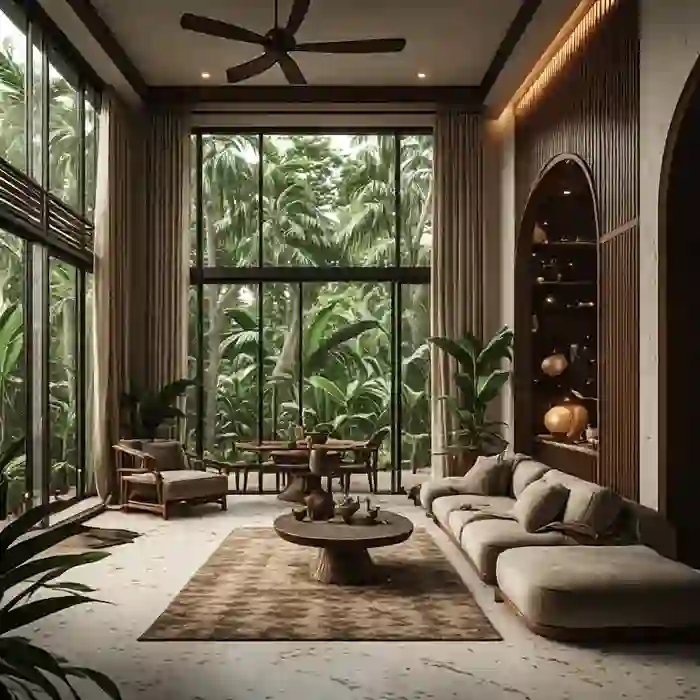
Before adapting Art Deco to a tropical climate, it helps to understand what makes the style recognisable in the first place.
Art Deco is less about a particular collection of furniture than a visual language.
Geometry
Geometry is one of its clearest signatures.
Stepped forms, fan shapes, sunbursts, arches, chevrons, circles and strong vertical lines create rhythm. Furniture, mirrors, wall panels, flooring and lighting can all participate in this geometric vocabulary.
But geometry does not have to mean decoration everywhere.
Sometimes a single architectural gesture — a curved doorway, a radial mirror or a symmetrical pair of lamps — is enough to establish the language.
Symmetry
Art Deco often likes balance.
A pair of armchairs. Two wall lights. A central pendant. Matching bedside tables.
Symmetry creates a feeling of order, which becomes particularly useful when the surrounding landscape is visually exuberant.
Outside, leaves move, shadows shift and vegetation grows in every direction.
Inside, the geometry holds the composition together.
Glamour
Art Deco enjoys materials that catch the eye.
Polished metal. Stone. Glass. Lacquer. Velvet. Rich timber.
But glamour does not necessarily mean extravagance.
A beautifully proportioned brass lamp against a dark timber wall can be more convincing than an entire room covered in metallic finishes.
Contrast
Light and dark.
Smooth and textured.
Matte and reflective.
Geometric and organic.
These contrasts are central to the Art Deco atmosphere.
They also become particularly interesting in the tropics, where the architectural environment already provides a strong contrast between bright daylight and deep shade.
Rich Materials
Traditional Art Deco interiors often celebrate luxurious materials.
Marble, brass, lacquered surfaces, exotic woods and decorative glass can all contribute to the feeling.
In a tropical climate, however, the question changes from:
“Does this material look luxurious?”
to:
“Will this material still look beautiful here?”
That distinction matters.
What Changes in a Tropical Climate?
Tropical adaptation is not about removing the character of Art Deco.
It is about choosing materials, colours and construction details that can live comfortably with heat, humidity, sunlight and outdoor living.
The visual language stays.
The practical vocabulary changes.
1. Brass and Metals: Let Them Age Beautifully
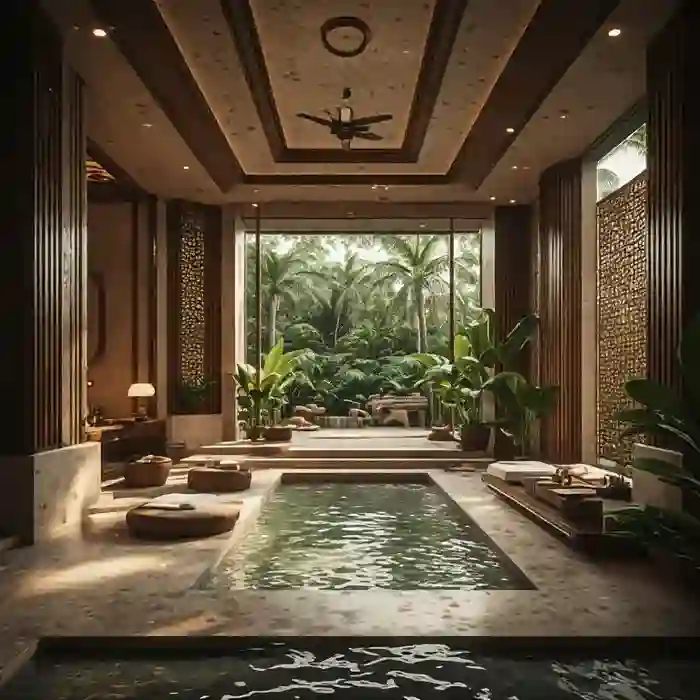
Brass is almost made for Art Deco.
Its warm metallic surface works beautifully with dark timber, marble, glass and rich colours.
In a tropical environment, however, metal finishes need more consideration.
High humidity and salty coastal air can accelerate corrosion or alter the appearance of some finishes.
Instead of treating this as a problem to hide, the design can work with it.
Choose finishes appropriate to the environment and specify corrosion-resistant hardware where necessary. In some settings, a gently aged brass appearance may actually feel more natural than an aggressively polished surface.
The goal is not to make every metal object look untouched.
It is to make sure that ageing looks intentional.
2. Marble: Cool, Graphic and Architectural
Marble brings two things to Art Deco interiors particularly well: luxury and pattern.
Its veining can become almost architectural when used on a large surface.
A marble console. A bathroom vanity. A floor border. A bar counter.
In a tropical interior, stone can also contribute visually to a sense of coolness.
But the most interesting approach is often restraint.
If the marble has dramatic veining, allow it to be the pattern.
There is no need for the curtains, wallpaper, cushions and carpet to compete with it.
Art Deco understands contrast.
It also understands when to stop.
3. Tropical Woods: Warmth Without Losing the Geometry
Dark woods have long been associated with sophisticated Art Deco interiors.
Tropical climates provide another opportunity: locally appropriate timber can introduce warmth and connect the interior to its landscape.
The key is to preserve the geometry.
A timber wall does not have to become rustic. A timber ceiling does not have to become tropical vernacular.
Precisely detailed panelling, fluted surfaces, geometric inlays or carefully proportioned cabinetry can keep the material firmly within an Art Deco vocabulary.
The result can feel richer than a room filled with imported “luxury” materials because the wood belongs to the place.
4. Ventilation: The Invisible Part of the Design
This is where tropical Art Deco becomes more architectural.
A beautiful room that cannot breathe is not successful tropical design.
Cross-ventilation, operable windows, ceiling fans, shaded openings, breezeways and carefully positioned doors can all influence the comfort of the space.
And they should not be treated as afterthoughts.
A ceiling fan, for example, can become part of the composition.
Look for forms with clean, sculptural lines rather than trying to conceal every functional element.
Traditional tropical architecture often understood something contemporary interiors sometimes forget:
air can be part of the architecture.
Art Deco simply gives it a more geometric frame.
5. Textiles: Luxury That Can Breathe
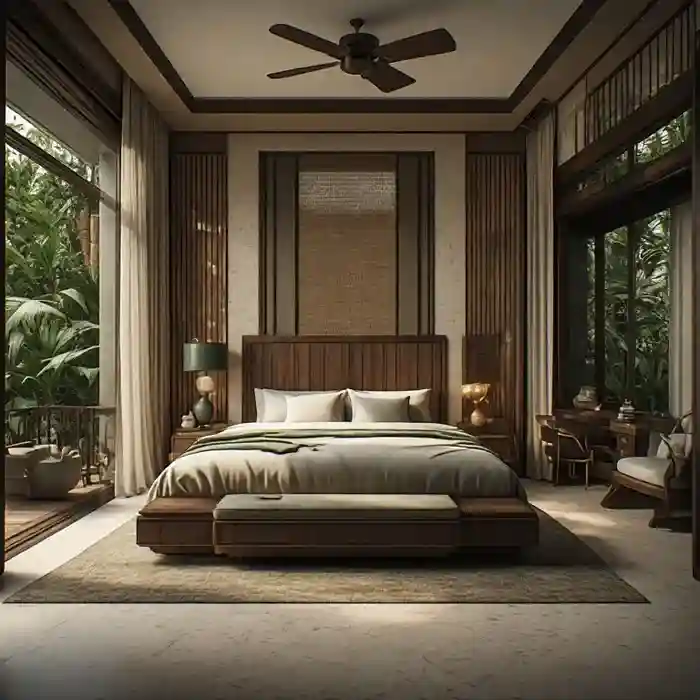
Textiles are where the idea of tropical glamour becomes particularly interesting.
Heavy velvet can look magnificent in an air-conditioned hotel lounge.
In a naturally ventilated tropical house, it may be a different story.
Lighter linens, cottons, breathable blends and appropriately selected performance fabrics can provide texture without making the room visually or physically heavy.
Curtains can become particularly important.
Instead of treating them simply as decoration, consider them as part of the climate strategy.
Sheer layers can soften strong daylight while heavier curtains provide privacy and shade when required.
The movement of fabric also introduces something that rigid Art Deco architecture sometimes lacks:
movement.
A geometric room becomes more atmospheric when the curtains respond gently to the air.
6. Lighting: From Tropical Daylight to Art Deco Evening
Tropical daylight is powerful.
It can make pale colours appear almost luminous and turn dark surfaces dramatically deep.
This means artificial lighting needs to be considered alongside daylight rather than separately from it.
During the day, filtered natural light can reveal the textures of marble, timber and fabric.
At night, the atmosphere can become much more theatrical.
Wall sconces, table lamps, concealed lighting and sculptural pendants can create pools of warm illumination rather than flooding the entire room with uniform brightness.
This is where Art Deco becomes especially convincing.
The tropical garden disappears into darkness.
The interior begins to glow.
Brass catches the light. Marble reflects it. Glass becomes luminous.
The room changes character.
And suddenly the original story makes sense:
1930s glamour + lush garden + evening cocktails.
7. Patterns: Geometry Meets Botanical Abundance
Art Deco patterns are often highly stylised.
Fans, rays, stepped motifs, zigzags and repeating geometric forms create visual order.
Tropical landscapes, meanwhile, are anything but orderly.
Leaves overlap. Shadows move. Vines climb. Flowers appear unexpectedly.
Rather than choosing between geometric and botanical patterns, combine them carefully.
A geometric rug can sit beneath furniture surrounded by large tropical leaves.
A fan-shaped wall detail can echo the silhouette of a palm without literally depicting one.
A geometric screen can divide an interior from a garden while allowing glimpses of vegetation beyond it.
The strongest combinations are often indirect.
The room does not need to announce:
“This is tropical!”
It simply needs to feel as though the landscape has influenced its rhythm.
8. Humidity: Beauty Needs Maintenance
Humidity is one of the less glamorous parts of tropical interior design.
It affects timber, textiles, metals, finishes and sometimes even the perception of colour.
Materials that work beautifully in a dry climate may require different specifications in a humid one.
This is particularly important for hospitality projects, where surfaces experience much more intensive use.
Easy-clean fabrics, suitable finishes, mould-resistant materials where appropriate, good air circulation and sensible maintenance routines can all influence the longevity of the design.
Luxury is not only about what something looks like on opening day.
It is also about how well it ages.
9. Colours Under Tropical Light
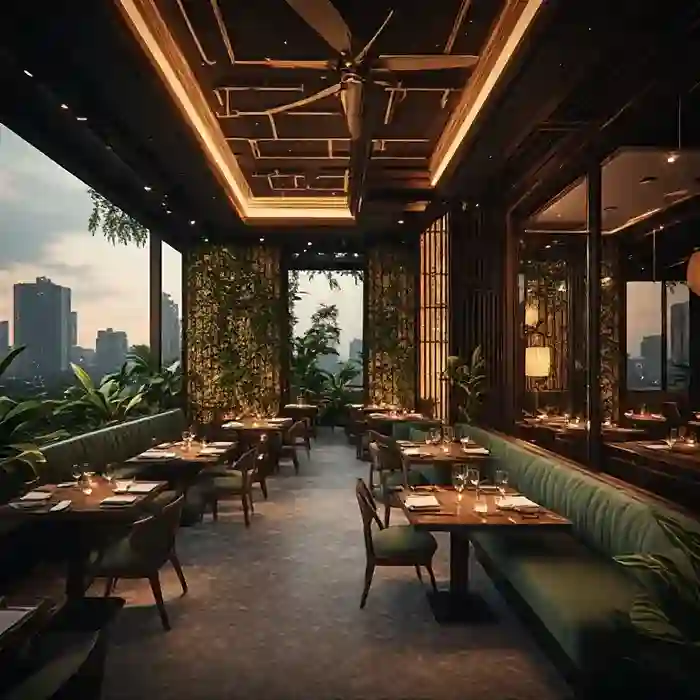
Colour behaves differently under strong natural light.
A colour that feels rich and sophisticated in a northern European interior can become much brighter under tropical sun.
This is where testing becomes more useful than colour theory alone.
Deep greens, petrol blues, warm creams, terracotta, tobacco, burgundy and muted gold can create a sophisticated palette, but their intensity needs to be considered in relation to the amount and direction of daylight.
Dark colours can become wonderfully dramatic in shaded interiors.
Pale colours can reflect the surrounding brightness and make a room feel almost weightless.
And metallic finishes can become surprisingly strong when hit by direct sunlight.
The best palette is therefore not simply an Art Deco palette.
It is an Art Deco palette filtered through tropical light.
10. The Interior–Exterior Transition
Perhaps the most important adaptation is not a material at all.
It is the relationship between inside and outside.
Traditional Art Deco imagery often suggests enclosed interiors: glamorous hotels, ocean liners, cinemas, cocktail bars and elegant apartments.
Tropical architecture offers another possibility.
The boundary can become porous.
Large openings, covered terraces, verandas, shaded patios, screened spaces and transitional lounges allow the interior to extend towards the garden.
Instead of creating one perfectly finished room, think about a sequence.
Interior.
Threshold.
Covered outdoor space.
Garden.
Each zone can carry elements of the same visual language.
A geometric floor pattern might continue onto a terrace.
The brass tone of an interior light might reappear in outdoor furniture.
A dark timber ceiling might extend towards a shaded veranda.
The result feels less like an indoor room decorated with tropical accessories and more like one continuous environment.
Tropical Art Deco Is About Atmosphere
This is where the design becomes more interesting than a checklist of materials.
Imagine entering a hotel just before sunset.
The marble floor is cool underfoot.
Dark timber frames the reception area.
A geometric brass detail catches the last daylight.
Beyond the open doors, large leaves move slowly in the garden.
The ceiling fan turns almost silently.
As the sky darkens, the artificial lighting begins to take over.
The garden becomes a silhouette.
The interior becomes warmer.
Glass, brass and marble start to glow.
This is not simply an Art Deco interior in the tropics.
It is a different story.
The architecture has borrowed Art Deco’s geometry and glamour, but the climate has changed its rhythm.
How to Create the Look Without Turning It Into a Theme
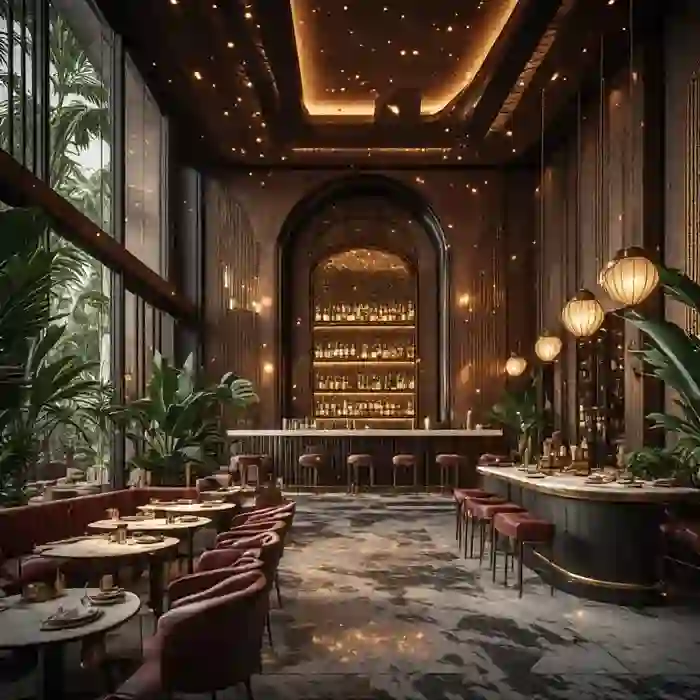
There is a fine line between a strong design language and a themed interior.
Tropical Art Deco does not need palm-tree wallpaper, gold everywhere and a cocktail bar in every corner.
In fact, too many obvious references can make the result feel more like a period set than a contemporary interior.
Instead, choose a few recognisable elements.
Perhaps:
- a strong geometric floor
- one sculptural brass light
- dark or richly coloured timber
- a marble surface
- carefully selected Art Deco furniture
- breathable natural textiles
- controlled botanical references
- warm evening lighting
- a strong connection to the garden
Then allow the architecture and climate to do some of the work.
The tropical character should come from how the space behaves, not simply from what has been placed inside it.
The Art Deco Tropical Design Formula
A useful way to think about the style is:
Art Deco structure + tropical materials + climatic intelligence + atmospheric lighting + garden connection.
The first element gives the interior its identity.
The second connects it to place.
The third makes it comfortable.
The fourth creates mood.
The fifth changes the relationship between inside and outside.
Remove any one of these and the result can become less convincing.
Too much Art Deco, and the room may feel like a historical reproduction.
Too much tropical decoration, and the geometry disappears.
Too much luxury, and the space becomes visually heavy.
Too much minimalism, and the glamour disappears.
The balance is the design.
The Story Matters More Than the Style
Perhaps this is the most useful lesson when adapting any historical design language to a different climate.
Do not begin with:
“How do I decorate this room in Art Deco style?”
Begin with:
“What should it feel like to be here?”
For tropical Art Deco, the answer might be:
1930s glamour + lush garden + evening cocktails.
Once that story is clear, the decisions become easier.
The marble can feel cool.
The brass can catch the sunset.
The timber can bring depth.
The curtains can move with the air.
The lighting can transform the room after dark.
The garden can become part of the composition.
And the geometry can remain beautifully, unmistakably Art Deco.
Because adapting a style to a climate is not about making the style weaker.
It is about giving it somewhere new to live.