
Lighting can transform a tropical interior long before anyone notices the furniture, the fabrics or the colour palette. It can make a hotel bedroom feel restful, give a restaurant terrace an intimate atmosphere or turn a simple holiday apartment into a place that feels carefully designed.
Yet lighting in tropical climates comes with its own challenges. Strong daylight, high humidity, warm evenings and the need for effective cooling all influence how a space should be illuminated. A room that looks inviting in a photograph may feel uncomfortable in reality if the lighting is too harsh, too yellow or poorly positioned.
The answer is not to make everything dimmer or to fill every corner with warm light. It is to understand how light interacts with materials, surfaces, architecture and the human experience of a space.
For hotels, resorts and holiday apartments, good tropical lighting is about creating atmosphere without adding unnecessary heat, wasting energy or compromising everyday comfort.
1. Warm Atmosphere Does Not Mean Yellow Light
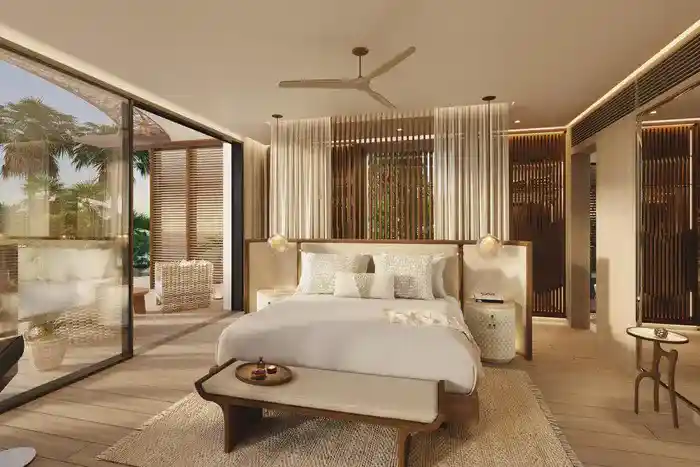
One of the most common approaches to creating a cosy interior is to use very warm, yellow-toned lighting. Although this can work in certain settings, applying it throughout an entire property can make colours appear dull, whites look creamy and natural materials lose some of their character.
In tropical interiors, where greenery, timber, stone, linen and woven fibres often play an important role, colour accuracy matters. A beautiful natural palette can easily become muddy under excessively yellow light.
The key is to distinguish between warmth of atmosphere and warmth of colour temperature.
Colour temperature is measured in kelvins (K). Lower values produce a warmer, more amber light, while higher values produce a cooler, whiter appearance.
For many hospitality interiors, the following ranges provide a useful starting point:
- 2700K: A soft, intimate light suited to relaxing bedrooms, bedside lamps and evening lounge areas.
- 3000K: A warm white that works well for general hospitality lighting, including living areas, restaurants and reception spaces.
- 3500K–4000K: A more neutral white that can be useful for mirrors, dressing areas, functional kitchens and certain work surfaces, depending on the materials and the desired atmosphere.
These are guidelines rather than fixed rules. The right choice depends on the architecture, the finishes, the amount of daylight and the activities taking place in the room.
In a tropical resort, for example, a bedroom might combine 2700K bedside lighting with discreet 3000K indirect lighting. A bathroom could use a warmer general light while providing a more neutral, high-colour-rendering source around the mirror.
The result feels layered rather than monochromatic.
Colour rendering is equally important. Look for lamps with a high Colour Rendering Index (CRI), ideally 90 or above where colour fidelity is important. This helps timber retain its natural tone, fabrics show their intended colours and skin appear more natural.
The objective is not to make a room look warm. It is to make it feel inviting while allowing its materials and colours to remain themselves.
2. Indirect Lighting: Let the Architecture Do the Work
One of the most effective ways to create sophisticated tropical interiors is to illuminate architectural surfaces rather than directing light everywhere from visible fixtures.
Indirect lighting works by bouncing light off ceilings, walls, niches or other surfaces. The light source itself is concealed or shielded, creating a softer visual effect with fewer distracting points of brightness.
In a hotel bedroom, concealed LED strips can be integrated into a headboard, a ceiling recess or a carefully designed wall detail. A gentle wash of light behind the headboard creates depth without requiring a bright central ceiling fixture.
In a holiday apartment, indirect lighting beneath a floating shelf or inside an architectural niche can make a compact living area feel more considered. It also helps separate functional zones without adding furniture or visual clutter.
In a resort lounge, concealed lighting along a timber ceiling or behind a textured stone wall can emphasise the architecture after sunset.
The most successful installations are planned as part of the design rather than added as an afterthought. The position of the light source, the distance from the illuminated surface and the finish of that surface all affect the final result.
A rough or textured wall produces a different effect from a smooth, pale ceiling. Timber absorbs and reflects light differently from polished stone. These variations can become part of the atmosphere.
There is, however, a practical consideration in tropical climates: concealed lighting must be designed to allow appropriate heat dissipation and maintenance. LED strips installed in unsuitable enclosed channels can overheat, shortening their lifespan. Drivers should remain accessible, and fixtures must be compatible with the installation environment.
Indirect lighting is most effective when it complements other sources. Used alone, it can leave a room visually flat or make everyday activities difficult. Combined with task and accent lighting, it creates a more flexible environment.
3. Natural Fibre Lampshades: Texture, Shadow and Tropical Identity
Rattan, bamboo, woven seagrass and other natural fibres are often associated with tropical interiors. Their appeal goes beyond their material character: when illuminated, they create patterns of light and shadow that can bring a room to life.
A woven pendant above a dining table, for instance, can introduce a subtle sense of movement to an otherwise simple interior. A pair of woven wall lights can soften a bedroom while reinforcing its connection to natural materials.
These effects work particularly well in resorts and boutique hotels, where lighting can contribute to a recognisable design identity without relying on elaborate decorative objects.
However, natural fibre lighting requires a little more consideration than its relaxed appearance might suggest.
Humidity can affect certain fibres, finishes and structural components. Poor ventilation, moisture exposure and unsuitable cleaning methods may lead to deterioration, deformation or mould. Natural materials should therefore be selected according to their intended location and the manufacturer’s care recommendations.
A woven pendant that works beautifully in a dry, air-conditioned bedroom may not be suitable for an exposed outdoor dining area.
For covered terraces and semi-outdoor spaces, consider fixtures specifically rated for the conditions in which they will be installed. Alternatives include durable synthetic woven materials designed for outdoor use, or metal and composite shades that reproduce the visual rhythm of natural weaving.
The light source matters, too. An exposed bulb inside an open weave can create distracting glare, especially when guests are seated below it. A shielded or diffused source often produces a more comfortable result.
LED lamps are generally a practical choice because they consume less energy and release less heat into the surrounding space than comparable incandescent lamps. Nevertheless, the bulb, driver and fixture still generate some heat, and enclosed shades must be suitable for the selected light source.
Natural fibre lighting should also be used selectively. If every pendant, wall light and decorative object is woven, the interior can begin to feel repetitive. One sculptural pendant, supported by quieter architectural lighting, is often more effective than a collection of competing fixtures.
The aim is to introduce texture and atmosphere, not to turn the entire room into a decorative statement.
4. Light and Shadow: The Most Underused Decorative Tools
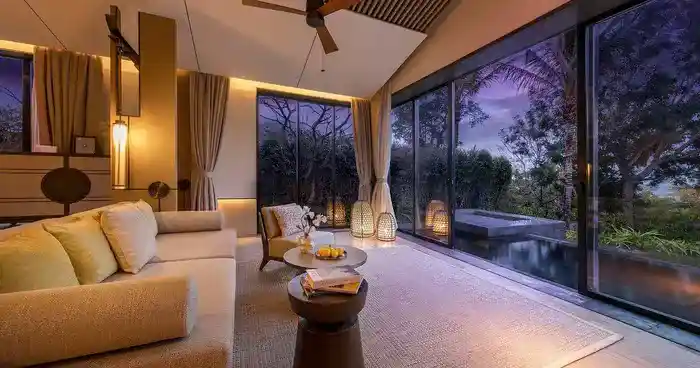
Tropical interiors are closely connected to the movement of daylight. Palm leaves cast shifting patterns, shutters filter the sun and deep roof overhangs create transitions between bright and shaded areas.
Artificial lighting can extend this visual language into the evening.
Rather than illuminating every surface evenly, consider how selected areas can remain in shadow while others receive gentle pools of light. This creates depth and makes a space feel more intimate.
In a restaurant, light falling across a textured wall can add character without requiring additional artwork. In a hotel bedroom, a softly illuminated curtain or a wall washed with light can become a quiet focal point.
On a covered terrace, directional lighting can highlight planting, architectural columns or the texture of a timber screen. The surrounding darkness becomes part of the composition.
The important distinction is between intentional shadow and poor visibility.
Guests should still be able to navigate safely, recognise changes in floor level and use tables, steps and circulation routes comfortably. In hospitality settings, atmospheric lighting must work alongside functional and safety lighting.
Avoid placing bright fixtures directly in the line of sight or allowing decorative lamps to create strong glare against dark backgrounds. Contrast can be beautiful, but excessive contrast may make it difficult for the eye to adapt.
A useful principle is to illuminate the elements that contribute to the experience of the space rather than trying to illuminate everything equally.
5. Architectural Lighting: Emphasising Materials Without Overheating the Interior
Architectural lighting can make a tropical property feel sophisticated without relying on an abundance of decorative lamps.
It draws attention to the structure of a space: the rhythm of ceiling beams, the depth of a doorway, the texture of a stone wall or the relationship between indoor and outdoor areas.
Recessed fixtures, wall washers, concealed LED profiles and carefully positioned spotlights can all contribute to this effect.
In a hotel lobby, a wall washer can reveal the texture of a natural stone surface. In a restaurant, discreet lighting integrated into joinery can make the bar feel visually distinct from the dining area. In a holiday apartment, a small number of adjustable spotlights can highlight artwork or architectural details without filling the ceiling with fittings.
In tropical climates, LED technology is particularly useful because it generally offers high energy efficiency and relatively low radiant heat compared with traditional incandescent lighting.
But there is an important distinction: reducing heat from lighting does not eliminate the need to manage the heat produced by the building itself.
All electrical lighting consumes energy, and some of that energy ultimately becomes heat. LED fixtures usually produce considerably less heat per unit of useful light than incandescent alternatives, but poorly ventilated fixtures, inefficient equipment and unnecessary illumination can still increase cooling demand.
For hotels and resorts, the choice of fixtures should therefore consider:
- Energy efficiency and the amount of light delivered for the electricity consumed.
- Heat dissipation and suitability for enclosed or recessed installations.
- Driver accessibility and ease of maintenance.
- Dimming compatibility and control systems.
- Moisture and dust protection appropriate to each location.
- The ability to replace components without damaging ceilings or wall finishes.
Exterior and semi-exterior installations need particular attention. Tropical conditions can combine high humidity, heavy rain, salt-laden air and insects. The appropriate ingress protection rating, corrosion resistance and installation details depend on the actual exposure, not simply on whether a fixture is labelled for outdoor use.
A well-designed lighting scheme is not only visually successful. It is also practical to maintain over years of operation.
6. Making the Most of Daylight Without Fighting It
In tropical climates, daylight is both a design resource and a challenge.
Bright sunshine can create dramatic interiors, but it can also produce glare, strong contrasts and unwanted solar heat gain. The solution is not necessarily to block natural light completely. It is to control how it enters the space.
Sheer curtains, adjustable blinds, external shading, deep overhangs and filtered screens can soften daylight while preserving a connection with the outdoors.
In a resort bedroom, a translucent curtain can diffuse the morning sun while allowing the room to remain bright. A heavier curtain or effective external shading can help control heat and glare when direct sunlight becomes intense.
In a holiday apartment, layered window treatments allow guests to adjust privacy, daylight and darkness according to their preferences.
Where possible, external shading is particularly valuable because it can intercept solar radiation before it passes through the glazing and heats the interior. Internal curtains still help control glare and improve comfort, but their thermal performance depends on their construction and placement.
Artificial lighting should respond to these changing daylight conditions.
During the day, a naturally bright living area may need only a small amount of supplementary lighting. As daylight fades, indirect lighting and selected accent fixtures can gradually take over.
Dimmable lighting and simple control systems make this transition easier. In larger hospitality properties, daylight sensors and occupancy controls can also reduce unnecessary energy consumption when appropriately configured.
The goal is to establish a relationship between natural and artificial light, rather than treating them as two separate systems.
A room should feel coherent at noon, at sunset and after dark.
7. Hotel Bedrooms: Lighting for Rest, Privacy and Practicality
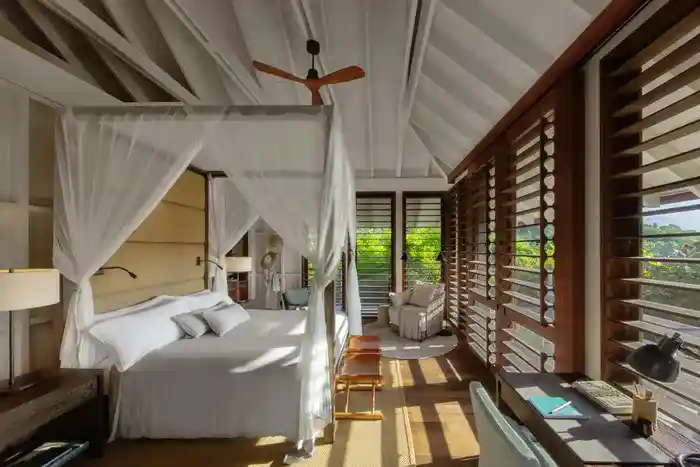
Hotel bedrooms need to perform several functions without feeling like brightly illuminated workspaces.
Guests may want to read, unpack, work, relax or prepare for sleep. A single ceiling light cannot accommodate all these activities comfortably.
A layered scheme is more effective.
General lighting provides sufficient illumination for moving around and completing everyday tasks. This might come from discreet ceiling fixtures, indirect cove lighting or a combination of both.
Task lighting supports specific activities. Adjustable bedside lamps or wall-mounted reading lights allow guests to read without illuminating the entire room. A properly lit dressing mirror makes getting ready easier.
Accent lighting adds atmosphere. It might highlight a headboard, a textured wall, a piece of artwork or the folds of a curtain.
These layers should operate independently wherever possible. Guests should not have to switch on every light simply to read in bed.
Controls also matter. A bedside switch that is difficult to locate in the dark is a small inconvenience that can affect the overall guest experience. Clear switching arrangements, accessible controls and intuitive dimming are particularly important in rooms used by people unfamiliar with the layout.
In tropical destinations, lighting should also support the relationship between the bedroom and its outdoor space. A softly illuminated balcony or planted courtyard can create visual depth through the glazing, provided exterior fixtures are carefully positioned to avoid reflections and glare.
The result should feel calm and comfortable, with enough flexibility for different guests and different times of day.
8. Covered Terraces: Extending the Interior into the Evening
Covered terraces are often among the most valuable spaces in tropical hospitality properties. They provide an outdoor experience while offering some protection from direct sunlight and rain.
Their lighting should preserve that sense of openness.
Instead of using a uniform grid of bright ceiling fixtures, combine a few different layers: gentle ambient light, illumination for dining or circulation, and selective lighting for planting or architectural features.
A pendant over a dining table can establish a focal point. Wall lights can define the perimeter, while discreet, shielded fixtures illuminate steps and changes in level.
Where natural fibre pendants are used, confirm that they are suitable for the actual humidity and exposure conditions. A roof alone does not guarantee protection from wind-driven rain, condensation or salt-laden air.
Outdoor-rated LED fixtures can reduce energy consumption and limit heat output compared with older lighting technologies. They should also be positioned to avoid shining directly into seated guests’ eyes or spilling unnecessarily into neighbouring properties and the night sky.
One of the most effective approaches is to allow the surrounding garden to remain partially dark. A few illuminated leaves, a softly lit trunk or a textured screen can create a stronger impression than brightly lighting every plant.
The terrace then becomes a transition between the comfort of the interior and the atmosphere of the tropical night.
9. Holiday Apartments: Good Lighting Without Unnecessary Complexity
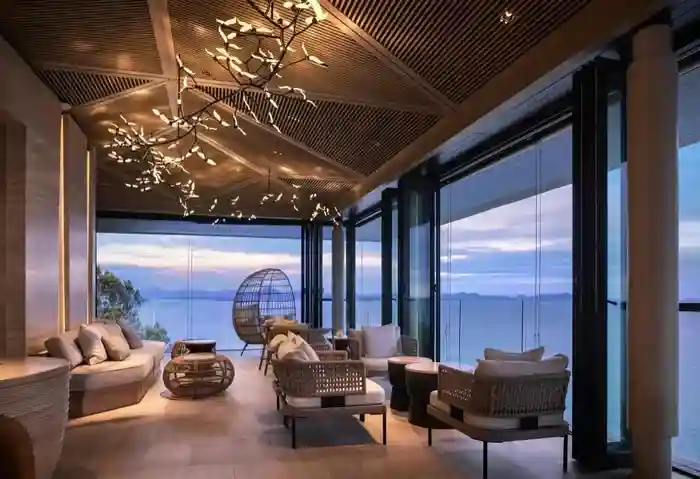
Holiday apartments face a different challenge from hotels. Their lighting must be attractive, durable and easy for guests to understand, often within a more limited budget.
A carefully planned scheme can improve the perceived quality of an apartment without requiring expensive decorative fixtures.
Start with the essentials:
- Provide comfortable general lighting in the living room and kitchen.
- Install independent bedside reading lights.
- Ensure that bathroom mirrors and kitchen worktops are adequately illuminated.
- Use dimmable or separately switched accent lighting where it adds genuine value.
- Avoid excessive decorative fixtures that complicate cleaning, maintenance or replacement.
Light can also help a small apartment feel more spacious. Illuminating a wall rather than directing all the light towards the centre of the room can make the boundaries feel less abrupt. Concealed lighting in a niche or beneath a shelf can introduce depth without occupying valuable floor space.
Colour consistency is important, too. A living room illuminated by several different shades of white may feel disjointed, particularly when the finishes are simple and the space is compact.
A coherent palette of colour temperatures, with carefully chosen exceptions for functional areas, generally produces a more polished result.
For properties managed remotely, standardised LED lamps and readily available replacement components can simplify maintenance. Simple controls reduce the likelihood of guests leaving unnecessary lighting switched on or struggling to understand complicated systems.
The best solution is often not the most elaborate one. It is the one that makes the apartment feel inviting while remaining easy to use and economical to operate.
10. Common Tropical Lighting Mistakes
Some lighting decisions can undermine an otherwise successful interior.
Using very yellow light everywhere. Excessively warm colour temperatures can distort natural materials and make pale interiors look dull. Choose colour temperature according to the activity, finishes and atmosphere.
Relying on a single central ceiling light. This often creates harsh shadows and leaves the room feeling flat. Introduce separate layers for general, task and accent lighting.
Installing LED strips without considering heat dissipation. LEDs are efficient, but unsuitable channels and enclosed fittings can shorten their lifespan. Specify compatible components and allow for ventilation where required.
Choosing natural fibre shades for unsuitable locations. Humidity, moisture and exposure can damage some materials. Match the fixture to the conditions and maintenance requirements.
Overlighting the garden or terrace. Excessive exterior illumination can erase the contrast between the building and its surroundings. Use selective lighting and shielded fixtures.
Ignoring daylight and solar gain. Artificial lighting cannot compensate for poor solar control. Shading, glazing, curtains and lighting controls should work together.
Making decorative lighting difficult to maintain. Intricate fixtures positioned above staircases or in inaccessible ceiling recesses can increase maintenance costs. Accessibility should be part of the original design.
Forgetting the guest’s point of view. A pendant may look beautiful in a photograph but produce glare when someone is seated at the dining table. Assess lighting from the positions in which people will actually use the space.
11. A More Thoughtful Approach to Tropical Lighting
The most successful tropical interiors do not depend on constant brightness. They use light to establish a rhythm between openness and intimacy, daylight and shadow, architecture and nature.
A hotel bedroom can feel restful without becoming dark. A restaurant terrace can feel sophisticated without being flooded with light. A holiday apartment can look carefully styled without relying on expensive decorative fixtures.
These effects emerge from a few considered decisions: selecting appropriate colour temperatures, illuminating architectural surfaces, using materials that respond beautifully to light, controlling daylight and choosing efficient, maintainable equipment.
For hospitality businesses, these decisions have practical consequences as well as visual ones. Efficient lighting and appropriate controls can reduce electricity consumption, while durable fixtures and accessible components can help manage maintenance costs. Better glare control and more flexible lighting can also improve guest comfort.
Ultimately, tropical lighting is not about reproducing the golden glow often associated with luxury interiors. It is about understanding the particular qualities of a place: the intensity of its daylight, the texture of its materials, the movement of its shadows and the way people inhabit it.
When those elements work together, atmosphere becomes a natural part of the architecture rather than something added at the end.
And that is where thoughtful lighting makes the greatest difference: not simply in how a space looks, but in how it feels to spend time there.
Tropical Lighting Design: Practical Recommendations and FAQs
What is the best lighting for hotels in tropical climates?
The best lighting for hotels in tropical climates combines energy-efficient LED fixtures, indirect architectural lighting, carefully selected colour temperatures and effective daylight control. A layered lighting scheme creates a comfortable atmosphere while reducing unnecessary electricity consumption and heat generation. Natural materials, textured surfaces and selective illumination can add visual depth without relying on excessively bright or yellow light.
How can you create warm lighting without making a tropical room feel hotter?
Use energy-efficient LED lighting instead of incandescent lamps, avoid unnecessary illumination and select fixtures that provide the required light with minimal energy consumption. LEDs generally release less heat into the surrounding space than comparable incandescent lamps, although their drivers and components still generate heat. Indirect lighting, dimmers and separate lighting controls can further improve comfort and reduce energy use.
What colour temperature is best for tropical hotel interiors?
A colour temperature of 2700K–3000K is a useful starting point for hotel bedrooms, lounge areas and evening hospitality spaces. Neutral white lighting around 3500K–4000K can be appropriate for selected task areas, such as dressing mirrors and kitchen worktops. The final choice should reflect the materials, daylight conditions, activities and desired atmosphere rather than following a single rule for every room.
How should lighting be designed for humid tropical environments?
Lighting in humid tropical environments requires fixtures suitable for the specific installation conditions. Consider moisture protection, corrosion resistance, heat dissipation, electrical safety and ease of maintenance. Covered terraces, bathrooms, outdoor dining areas and air-conditioned bedrooms have different requirements. Natural fibre lampshades should also be selected according to their moisture tolerance and the manufacturer’s recommendations.
How can natural materials improve tropical lighting design?
Natural materials such as timber, stone, linen, rattan and woven fibres interact with light in different ways. Textured surfaces create subtle shadows, woven lampshades produce patterned light, and indirect illumination reveals the grain and relief of materials. Using these effects selectively creates a richer atmosphere while preserving the natural character of the interior.
What is the best lighting approach for tropical holiday apartments?
Tropical holiday apartments benefit from simple, flexible lighting with separate controls for general illumination, reading, cooking and decorative accents. Energy-efficient LEDs, coordinated colour temperatures and accessible replacement components help balance guest comfort, visual quality and maintenance costs. Effective window shading should complement the artificial lighting to control glare and solar heat gain.
How can outdoor lighting create atmosphere in tropical resorts?
Outdoor lighting works best when it highlights selected architectural features, dining areas, pathways and plants rather than illuminating the entire landscape uniformly. Shielded fixtures, suitable outdoor-rated equipment and restrained light levels create visual depth while reducing glare and unnecessary light spill. In covered terraces, combine ambient lighting with focused illumination for dining and safe circulation.
What is the difference between warm light and a warm atmosphere?
Warm light refers primarily to the colour appearance of a light source, commonly associated with lower colour temperatures measured in kelvins. A warm atmosphere is a broader design effect created through lighting intensity, contrast, shadows, materials, colour, spatial arrangement and the relationship between indoor and outdoor spaces. A tropical interior can feel inviting without relying exclusively on very warm or yellow lighting.
Key principles of tropical lighting design
For hotels, resorts and holiday apartments, effective tropical lighting design follows five practical principles:
- Use energy-efficient lighting: Choose appropriate LED fixtures and avoid unnecessary illumination.
- Layer different light sources: Combine ambient, task and accent lighting to support different activities.
- Respect natural materials: Use light to reveal textures without distorting their colours.
- Control daylight and glare: Coordinate artificial lighting with shading, curtains and architectural features.
- Design for the climate: Specify fixtures, finishes and maintenance strategies suited to local humidity and exposure conditions.
The result is a tropical interior that feels comfortable, visually sophisticated and practical to operate throughout the day and into the evening.