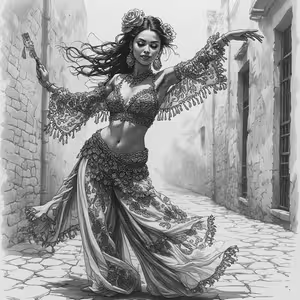
How to Make Polyester Costumes Look Luxurious Under Stage Lights and on Camera
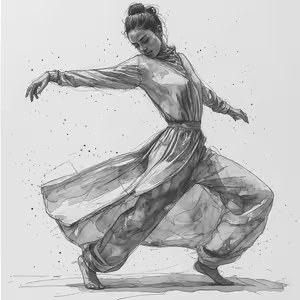
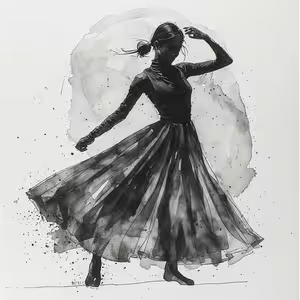
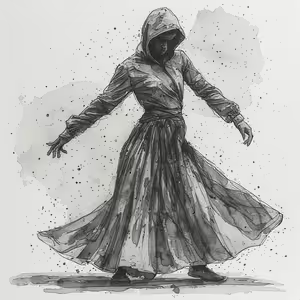
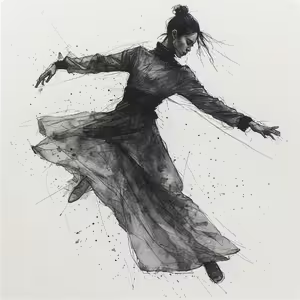
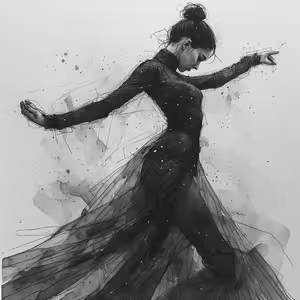
Light Is Direction Before It Is Brightness
Walk into an empty theatre during a lighting rehearsal and you may notice something curious. The lighting designer is rarely asking for more light. More often than not, they are asking for a fixture to move a few degrees to the left, to tilt slightly downward, or to be raised by half a metre.
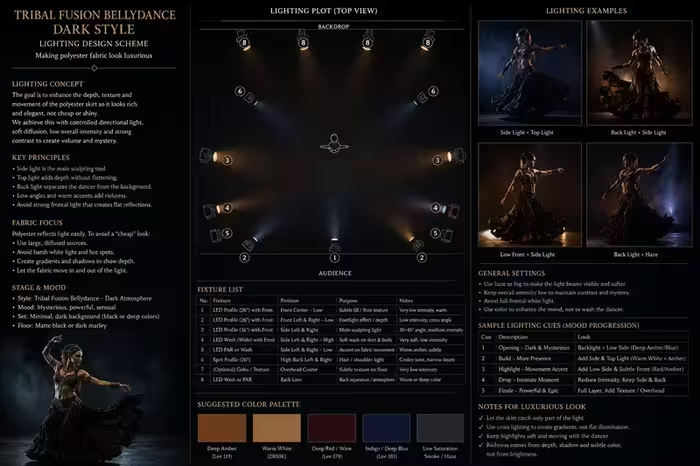
To someone unfamiliar with stage lighting, these adjustments may seem insignificant. After all, how much difference can a few degrees possibly make?
To a costume, they can mean everything.
The temptation—especially for those new to theatre or dance cinematography—is to think of lighting as a matter of intensity. If a performer is difficult to see, we instinctively add more light. If a costume appears dull, we increase the brightness. If the camera struggles to expose the scene, we raise the output of the fixtures.
Yet brightness is only one characteristic of light, and often not the most important one.
Direction is.
Light behaves much like rain falling across a landscape. Rain descending vertically reveals different textures than rain carried sideways by the wind. It gathers in different places, creates different patterns and changes the appearance of every surface it touches.
Light behaves in precisely the same way.
Its direction determines whether a fabric appears flat or sculptural, luxurious or inexpensive, soft or glossy. The quantity of light certainly matters, but the path that light follows matters even more.
When working with polyester, this principle becomes the foundation of every successful lighting design.
The question is never simply, “How much light should reach the costume?”
The more important question is:
“Where should that light travel after it touches the fabric?”
Understanding the Journey of Light
Every beam emitted by a lighting fixture follows a remarkably simple sequence.
It leaves the source.
It strikes the performer.
It interacts with the fabric.
It reflects toward the surrounding environment.
Some of those reflected rays eventually reach the audience or the camera.
This final step determines almost everything we perceive.
Imagine throwing a stone across a calm lake.
Depending on the angle, the stone may skim across the surface or disappear beneath it. Light behaves according to equally predictable geometry. When a spotlight approaches a smooth polyester costume from almost the same direction as the audience’s gaze, the reflected light naturally travels back toward them.
The result is familiar to anyone who has photographed synthetic fabrics.
A brilliant white highlight appears across the chest, shoulders or sleeves. Details disappear. Colours become washed out. The costume suddenly resembles polished plastic rather than woven cloth.
Nothing about the textile has changed.
Only the geometry has.
This is why experienced lighting designers often solve reflective problems without changing a single costume.
Instead, they change the path of the light.
The Deceptive Simplicity of Front Light
Front lighting is one of the oldest and most essential tools in stage design.
Without it, audiences struggle to see facial expressions. Eyes disappear into shadow. Emotional communication becomes more difficult.
For this reason alone, front light will always remain indispensable.
Its purpose, however, is frequently misunderstood.
Front light should reveal performers.
It should not dominate costumes.
The difficulty begins when frontal fixtures become too powerful or too closely aligned with the audience’s viewpoint.
In that position, polyester behaves almost like thousands of microscopic mirrors arranged across the garment. Each fibre reflects a tiny portion of the incoming beam, and together these countless reflections merge into one broad area of glare.
Ironically, increasing the intensity often makes the situation worse.
The costume becomes brighter, but not necessarily more beautiful.
Texture begins to disappear because the shadows that define it are overwhelmed by direct illumination. Wrinkles lose their depth. Pleats become flatter. Embroidery becomes less noticeable. Rich colours lose some of their subtle variations because every surface receives nearly the same amount of light.
The audience sees more brightness.
They perceive less detail.
This explains why professional productions rarely depend on front light alone.
It is only one voice in a much larger lighting composition.
Why Side Light Has Become the Language of Dance
If theatre teaches us to look at faces, dance teaches us to look at bodies.
Every extension of an arm, every turn of the torso and every unfolding movement depends upon the audience’s ability to perceive shape rather than merely brightness.
For this reason, side lighting has become almost synonymous with dance.
Unlike frontal illumination, side light travels across the performer instead of directly toward the audience. As it glides along the surface of the costume, every fold becomes visible through gentle transitions between highlight and shadow.
The body acquires volume.
The costume acquires texture.
Movement becomes easier to read.
Polyester benefits enormously from this arrangement.
Because the strongest reflections are redirected away from the audience, the fabric no longer announces its synthetic nature quite so loudly. Instead of producing a single distracting hotspot, the light stretches into softer bands that travel gracefully across the garment as the dancer moves.
This subtle transformation changes the emotional quality of the costume.
Rather than appearing glossy, it begins to appear fluid.
Rather than resembling plastic, it begins to resemble woven textile.
This is one of the reasons why many experienced dance lighting designers consider side light not merely an aesthetic choice but a practical necessity.
It allows the costume to participate in the choreography rather than compete with it.
The Quiet Power of High Side Lighting
Among lighting designers, there is a saying that rarely appears in textbooks:
“If you want to reveal movement, let the light arrive from where the movement begins.”
High side lighting embodies this philosophy beautifully.
Mounted above head height but well to either side of the stage, these fixtures illuminate performers from an angle that closely follows the natural architecture of the human body.
Shoulders, arms and legs become subtly modelled.
Flowing skirts reveal layers that frontal illumination often hides.
Loose sleeves separate gently from the torso.
Hair acquires delicate highlights without becoming overly bright.
Perhaps most importantly, high side lighting avoids striking large areas of polyester at a perpendicular angle.
The reflections therefore spread naturally across the garment rather than returning directly toward the audience.
The difference may appear modest on paper.
On stage, it can transform the entire visual impression of a costume.
Many productions discover that simply replacing part of their frontal illumination with carefully balanced high side lighting produces a richer result than purchasing entirely new costumes.
It is one of those rare improvements that costs little yet changes everything.
Back Light: Separating the Performer from the Darkness
Every painter understands that contrast creates depth.
Lighting designers achieve the same effect with back light.
Placed behind the performer, these fixtures outline the silhouette with a gentle rim of illumination. They separate dancers from dark scenery, define movement and create the impression that the performer occupies real three-dimensional space rather than standing against a painted backdrop.
Used carelessly, back light can become harsh and distracting.
Used thoughtfully, it becomes almost invisible.
Its purpose is not to draw attention to itself but to create breathing space around the performer.
Polyester responds particularly well to restrained back lighting because the brightest reflections remain confined to the edges of the garment. The front surface—where audiences naturally concentrate their attention—stays comparatively calm.
This balance preserves richness in darker colours while allowing lighter fabrics to retain their shape without excessive glare.
A carefully controlled rim of light can make even a modest costume appear carefully tailored.
Again, the fabric has not changed.
Only the way in which it meets the light.
Building Light Like Music
Perhaps the greatest misconception about stage lighting is the belief that each fixture performs an independent task.
In reality, lighting resembles an orchestra far more than a collection of individual instruments.
A violin played alone may sound beautiful, but its role changes entirely when joined by cellos, woodwinds and brass. None of the musicians attempts to dominate every moment. Instead, each contributes a different colour, texture and emotional quality to the whole.
Lighting works in much the same way.
Front light provides clarity.
Side light reveals texture.
High side light enhances movement.
Back light creates separation.
None of these elements should overpower the others.
Instead, they overlap gently, each compensating for the limitations of the rest.
This layered approach is especially valuable when working with polyester because it avoids relying on any single direction of illumination. Reflections become distributed rather than concentrated. Shadows remain soft without disappearing altogether. The costume begins to feel dimensional instead of glossy.
It is tempting to think of this process as hiding the synthetic qualities of the fabric.
That is not quite what is happening.
The lighting designer is doing something far more subtle.
They are guiding the audience’s attention.
Human perception is remarkably selective. We notice what the light encourages us to notice. If the brightest feature of a costume is a sharp reflection, our eyes will inevitably travel toward it. If, instead, the light reveals graceful movement, sculpted folds and harmonious colour, the fabric itself quietly fades into the background.
The audience does not stop seeing the costume.
They simply begin seeing the performer first.
That shift in attention is the true art of lighting design.
And perhaps the greatest compliment a lighting designer can receive is that no one notices the lighting at all. The audience leaves remembering the dancer, the atmosphere and the emotion of the performance, never realizing that every beam of light had been carefully composed to guide their gaze with almost invisible precision.
In the next part of this chapter, we will examine how different lighting instruments—Fresnels, PAR fixtures, profile spots, COB LEDs and modern diffused sources—shape polyester in remarkably different ways, and why the quality of the beam is often just as important as its direction.
The Character of Light Is Determined by Its Source
Two lighting fixtures may produce exactly the same illumination level on a stage, yet create entirely different costumes before the audience’s eyes.
This is one of the beautiful paradoxes of lighting design.
We often measure light in lux, foot-candles or lumens because these values are objective and easy to compare. But the audience never experiences light as numbers. They experience its character.
Light can be gentle or unforgiving.
It can whisper across a costume or strike it with relentless precision.
It can reveal every fibre or merely suggest the form beneath the fabric.
For polyester, these differences are particularly important because the material faithfully records the personality of every beam that touches it. A harsh source creates harsh reflections. A soft source creates graceful ones. An uneven beam exaggerates imperfections, while a smooth field of illumination allows the costume to breathe.
The fixture itself does not determine elegance.
Its quality of light does.
Learning to recognise that character is one of the great transitions from simply operating lighting equipment to truly designing with light.
Fresnels: The Gentle Brush
Among the many instruments found in theatres around the world, few have earned such lasting affection as the Fresnel.
Its popularity has never depended on producing the brightest beam or the sharpest focus. Quite the opposite. Designers value the Fresnel because it is forgiving.
Its edges dissolve gradually rather than ending abruptly. Shadows overlap softly. Brightness fades almost imperceptibly toward the perimeter of the beam.
The result resembles the stroke of a broad paintbrush.
Polyester responds beautifully to this type of illumination.
Instead of producing hard-edged reflections that immediately attract attention, Fresnels allow highlights to spread gently across the surface. Colours remain saturated. Folds retain their modelling. Even darker fabrics preserve a sense of depth because transitions between light and shadow remain smooth.
For decades, dance productions relied heavily upon Fresnels for precisely this reason.
They sculpt rather than expose.
Although LED technology has transformed modern stages, many lighting designers still attempt to recreate the visual softness traditionally associated with Fresnel optics.
Not because the instrument is old.
But because its behaviour remains timeless.
PAR Fixtures: Energy and Precision
PAR fixtures possess a very different personality.
Their beams are more assertive.
The centre of the light often carries greater intensity, creating stronger directional emphasis. This characteristic can be extraordinarily effective for energetic performances, concerts and productions requiring bold visual impact.
With polyester, however, restraint becomes essential.
An undiffused PAR fixture aimed directly at a performer may produce concentrated highlights that reveal every reflective quality of the fabric. Satin finishes become noticeably brighter. Smooth synthetic weaves begin to sparkle in ways that distract from movement.
This does not mean PAR fixtures should be avoided.
Far from it.
When positioned thoughtfully from the side or slightly behind the performer, they become powerful sculptural tools. Their directional nature can emphasise the rhythm of choreography, define muscular movement and create dramatic separation without allowing reflections to dominate the front of the costume.
Like many theatrical tools, their effectiveness depends less upon the instrument itself than upon the intelligence with which it is used.
Profile Spotlights: Precision with Responsibility
If the Fresnel is a paintbrush, the profile spotlight is a drawing pen.
Its beam can be shaped with extraordinary accuracy. Edges may be softened or sharpened. Gobos project intricate textures. Shutters define clean architectural boundaries.
This precision has made profile fixtures indispensable for theatre.
Yet precision carries responsibility.
A sharply focused profile directed squarely onto polyester can behave almost like sunlight reflected from polished stone. Every wrinkle becomes obvious. Every highlight acquires crisp definition.
Fortunately, profile fixtures also offer remarkable control.
A slight softening of focus often transforms their appearance completely. Diffusion filters further broaden reflections while preserving excellent control over the illuminated area.
For costumes made primarily of synthetic fibres, many designers deliberately avoid razor-sharp focus unless dramatic effect demands it.
The objective is not merely accurate illumination.
It is flattering illumination.
Modern LED Sources
Perhaps no technological development has changed stage lighting more profoundly than the widespread adoption of LED fixtures.
They consume less power.
Generate less heat.
Offer extraordinary colour flexibility.
Require far less maintenance than traditional tungsten systems.
Yet their arrival also introduced new aesthetic challenges.
Many early LED fixtures behaved almost like collections of tiny point sources. Multiple coloured emitters produced fragmented reflections across glossy fabrics, sometimes creating a sparkling appearance that never existed under tungsten illumination.
Modern fixtures have evolved dramatically.
COB (Chip-on-Board) LEDs produce a single, unified source that more closely resembles traditional incandescent lamps. Advanced optical systems create smoother beams with improved colour consistency.
Even so, polyester remains an excellent indicator of beam quality.
If an LED fixture produces uneven illumination, synthetic fabrics will reveal it immediately.
If the beam contains abrupt transitions, the costume will display them.
If colour rendering is poor, the garment will faithfully expose those limitations.
In this sense, polyester becomes an unexpectedly honest critic of lighting technology.
Diffusion: Teaching Light to Become Gentle
There is a curious irony in professional lighting.
Expensive fixtures are often placed behind surprisingly simple materials.
Silk.
Grid cloth.
Frost.
Tracing paper.
Diffusion fabrics.
At first glance this seems counterintuitive.
Why spend thousands on sophisticated equipment only to place fabric in front of it?
Because diffusion changes the language of light.
Without it, a beam behaves as a clearly defined object.
With it, the beam becomes an atmosphere.
Instead of striking a costume from one precise direction, countless tiny rays now arrive from subtly different angles. Reflections broaden. Shadows soften. Transitions become almost invisible.
Polyester responds to this transformation with remarkable generosity.
The familiar glossy hotspots begin to dissolve into wider luminous areas that the eye interprets as texture rather than glare.
For dance cinematography, diffusion is often one of the least expensive improvements capable of producing one of the greatest visual benefits.
The temptation is always to purchase more powerful fixtures.
Often, the wiser investment is simply to soften the light already available.
Colour Rendering: The Difference Between Accuracy and Beauty
Modern lighting discussions frequently revolve around technical specifications.
CRI.
TLCI.
TM-30.
These numbers matter, but only if we understand what they represent.
A lighting fixture with poor colour rendering does not merely reproduce colours inaccurately.
It simplifies them.
Subtle variations disappear.
Rich burgundy becomes ordinary red.
Deep emerald begins to resemble green paint.
Dark cherry loses its warmth.
Polyester is particularly sensitive to these changes because its smooth surface reflects both the colour of the fabric and the spectral characteristics of the light illuminating it.
High-quality fixtures preserve complexity.
Lower-quality fixtures compress it.
The audience may never identify the reason consciously, but they often describe the result instinctively.
One costume appears luxurious.
Another appears flat.
The difference frequently lies not in the garment but in the quality of the spectrum illuminating it.
Colour Temperature Is Emotional Architecture
Earlier we considered colour temperature from the perspective of texture.
Its emotional influence deserves equal attention.
Lighting is capable of changing not only what a costume looks like but what it feels like.
Warm amber illumination wraps a performer in intimacy.
Neutral white creates honesty and balance.
Cool blue-white light introduces emotional distance, precision and modernity.
Polyester reacts differently to each environment.
Deep reds become richer beneath warmer illumination.
Midnight blues acquire quiet dignity.
Emerald greens become jewel-like rather than synthetic.
Cooler temperatures may intentionally emphasise the modern qualities of a production, but they also increase the visibility of reflective highlights.
This is neither good nor bad.
It is simply another artistic decision.
The mistake lies in allowing technology to choose accidentally what aesthetics should decide deliberately.
Every production tells its own story.
The light should speak the same language.
Building Light in Layers
One of the defining characteristics of mature lighting design is restraint.
Beginners often search for the perfect fixture.
Experienced designers search for the perfect combination.
Rarely does a single source create an entire scene.
Instead, lighting grows gradually.
A gentle front wash provides clarity.
Side light introduces texture.
Back light creates separation.
A soft fill preserves detail in the shadows.
Each element performs a modest task.
Together they create something that no individual fixture could achieve alone.
This layered philosophy proves especially valuable for polyester because it prevents any single beam from becoming visually dominant.
Instead of producing isolated hotspots, reflections become distributed across multiple directions.
Instead of shouting, the light begins to converse.
The audience no longer notices where one fixture ends and another begins.
They simply perceive atmosphere.
The Invisible Craft
Perhaps the most rewarding aspect of lighting design is that its greatest successes often remain unnoticed.
No audience member leaves a theatre praising a perfectly balanced side fill or an exquisitely diffused Fresnel.
They remember the dancer suspended in light.
The richness of a deep blue costume.
The warmth of a final embrace.
The sensation that every movement possessed weight, elegance and purpose.
This is precisely as it should be.
Good lighting does not ask to be admired.
It quietly persuades the audience to believe what they see.
Polyester, despite its reputation, is fully capable of becoming part of that illusion.
Its fibres cannot change.
Its chemistry remains the same.
Yet chemistry alone has never determined beauty.
Beauty emerges from relationships—between light and shadow, colour and movement, performer and audience.
Every carefully positioned fixture contributes to that relationship.
Every softened highlight protects the illusion.
Every thoughtful choice reminds us that luxury on stage is rarely created by expensive materials alone.
More often, it is created by the intelligence with which light is invited to dance across them.
As we move into the next chapter, we will leave the stage for the camera, exploring how digital sensors, exposure, lenses and colour grading perceive polyester differently from the human eye—and how understanding those differences allows filmmakers and dance cinematographers to preserve the same elegance on screen that audiences experience in the theatre.