How to Make Polyester Costumes Look Luxurious Under Stage Lights and on Camera
Every Costume Begins with Light
Long before an audience notices the choreography, the music, or even the costume itself, another performance has already begun. It takes place in silence, often hours before the theatre doors open. A lighting designer walks slowly across the auditorium, pausing every few metres to study how a beam falls across the stage. A costume designer adjusts the sleeve of a dress beneath a rehearsal light. A camera operator slightly tilts a lens, watching highlights drift across a moving body. These quiet moments rarely receive applause, yet they determine much of what the audience will ultimately perceive.
A costume never possesses a fixed appearance.
Hanging from a rack in a dressing room, it is simply fabric—carefully cut, stitched, and coloured, but still incomplete. Only when light reaches its surface does it acquire volume, depth, texture and atmosphere. Shadows begin to define folds that did not previously exist. Colours become richer or flatter. Surfaces appear soft, heavy, delicate or coarse. In many ways, light does not merely illuminate a costume; it finishes designing it.
This idea is particularly important when working with polyester.
Among all the fabrics commonly used in dance, theatre and live performance, polyester is perhaps the one most frequently misunderstood. It is often criticised for looking artificial under stage lighting, as though the material itself were responsible for its reputation. Yet experienced lighting designers know that the fabric is only one participant in a much larger conversation. The beam, the angle, the colour temperature, the movement of the performer, the lens of the camera and even the background scenery all influence how polyester will finally appear.
A costume that seems inexpensive beneath one lighting setup may appear unexpectedly luxurious beneath another. Likewise, an expensive garment can lose all of its elegance if illuminated carelessly. The audience rarely sees the fabric itself. They see light reflected by the fabric, and from those reflections their brain constructs an impression of quality.
This distinction is subtle but profound.
It reminds us that we are not really designing costumes for the eye alone. We are designing interactions between light and matter.
Understanding that relationship changes everything.
Why Our Eyes Associate Shine with Cheapness
It is worth asking a simple question.
Why does glossy polyester often look inexpensive, while a softly illuminated wool coat or a velvet costume immediately suggests richness and craftsmanship?
The answer is not entirely cultural, nor is it simply a matter of fashion. It is rooted in the way the human visual system interprets surfaces.
Our brains constantly evaluate texture by observing how light behaves across it. We instinctively search for clues that tell us whether a surface is smooth or rough, dense or lightweight, soft or rigid. Long before we consciously identify a fabric, we have already formed an impression of its physical qualities.
Imagine walking through an old forest shortly after rain.
The bark of the trees absorbs light unevenly. Moss scatters it gently in every direction. Fallen leaves glow softly beneath a cloudy sky. Nothing reflects a perfect image because nature is full of microscopic irregularities. Every surface breaks the incoming light into countless subtle variations.
Natural textiles behave in much the same way.
Cotton, linen and wool possess fibres with irregular shapes and complex internal structures. When light strikes them, it is scattered in many directions at once. Instead of producing sharp reflections, these materials create gradual transitions between highlights and shadows. To our eyes, this scattered light suggests depth, softness and complexity.
Polyester tells a different story.
Its synthetic fibres are generally smoother and more uniform. Rather than dispersing light randomly, they reflect a greater proportion of it in predictable directions. The result is known as specular reflection—the same optical principle that allows polished metal, calm water or glass to produce bright highlights.
Of course, polyester is not a mirror.
Its reflections are much softer and more diffuse than polished chrome or glass. Nevertheless, when thousands of smooth fibres reflect light simultaneously, their combined effect creates the familiar glossy sheen that audiences instinctively associate with synthetic materials.
The important point is this:
The shine itself is not the problem.
The problem arises when that shine dominates everything else.
If the brightest element of a costume is its reflected highlight rather than its colour, texture or silhouette, the illusion begins to collapse. The audience stops seeing the costume as clothing worn by a character and starts noticing the material from which it is made.
That is rarely the goal of theatrical lighting.
Polyester Is Not the Enemy
One of the most persistent myths in costume design is that polyester inevitably looks cheap.
Anyone who has worked in professional theatre knows that this is simply untrue.
Polyester appears in opera productions, Broadway musicals, television dramas, touring dance companies and international fashion collections. It is used because it is remarkably practical. It withstands repeated washing, tolerates sweat, resists wrinkling, accepts vivid dyes and survives the physical demands of performance far better than many natural fibres.
If polyester were incapable of looking elegant, it would have disappeared from professional costume departments decades ago.
Instead, what professionals have learned is something much more interesting.
Rather than fighting the material, they design around its optical behaviour.
A lighting designer rarely asks, “How can I hide this fabric?”
Instead, they ask, “How can I encourage the audience to notice everything except its most reflective qualities?”
This change in perspective is remarkably powerful.
The objective is not to eliminate every highlight. Highlights are essential. Without them, fabrics appear flat and lifeless. Even velvet, often considered the least reflective of stage fabrics, depends on carefully controlled highlights to reveal the direction of its pile.
Luxury is not the absence of reflection.
Luxury is the control of reflection.
The finest tailoring, the richest silks and the most beautiful velvets all reflect light. They simply do so with restraint, allowing highlights to complement the form rather than dominate it.
Polyester deserves the same treatment.
Light Is a Sculptor
Perhaps the easiest way to understand stage lighting is to stop thinking of it as illumination.
Imagine instead that every lighting fixture is a sculptor’s chisel.
A sculptor does not create a figure by adding material everywhere equally. They remove stone selectively, revealing shape through contrast.
Light behaves in much the same way.
Every beam that reaches a performer is constantly sculpting the body and the costume. It deepens one fold while flattening another. It sharpens an edge here and softens a contour there. Two identical costumes can appear entirely different simply because the light strikes them from different directions.
This is why experienced lighting designers often spend more time adjusting angles than increasing intensity.
Brightness alone rarely creates beauty.
Direction does.
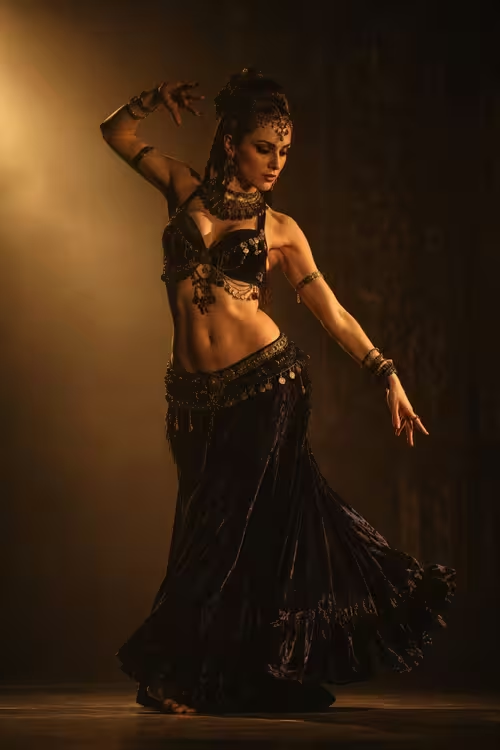
A powerful spotlight placed directly in front of a performer may reveal every detail of the costume, yet paradoxically it often removes its sense of depth. The garment becomes evenly illuminated, every wrinkle receives the same treatment, and the surface begins to resemble a flat sheet rather than a three-dimensional object.
Shift that same fixture thirty degrees to one side and something remarkable happens.
Folds begin to cast gentle shadows. Texture emerges. The silhouette becomes more sculptural. Reflections slide across the fabric instead of staring directly back at the audience.
Nothing about the costume has changed.
Only the direction of the light.
This simple observation lies at the heart of every successful lighting design.
The quality of a fabric depends far less on how much light reaches it than on how intelligently that light is allowed to travel across its surface.
The Stage and the Camera See Different Worlds
One final idea deserves attention before we begin discussing practical lighting techniques.
The human eye and a modern digital camera do not experience the world in the same way.
An audience seated in a theatre constantly adapts to changing brightness. Our pupils expand and contract almost without our noticing. Our visual system compensates for enormous differences in contrast, allowing us to perceive detail simultaneously in shadow and highlight. We rarely become distracted by small reflections because our brain instinctively prioritises faces, movement and gesture.
A camera has no such instincts.
Its sensor records light with relentless impartiality. A highlight that seems barely noticeable to a spectator may exceed the sensor’s dynamic range, becoming a featureless patch of white. A slight sheen that the eye naturally ignores may become the brightest object in the entire frame.
This explains why a costume can appear elegant during a live rehearsal and unexpectedly artificial when viewed on a monitor moments later.
The camera is not revealing a flaw that the audience somehow missed.
It is observing the same light under different limitations.
Learning to work with polyester therefore means learning to satisfy two very different observers: the adaptable human eye and the uncompromising digital sensor.
Fortunately, the principles that achieve this balance are neither mysterious nor prohibitively expensive. More often than not, they rely on understanding one fundamental truth:
The beauty of a costume is rarely determined by the fabric alone.
It is determined by the dialogue between fabric and light—a dialogue that, when carefully composed, allows even the most modest material to take on an entirely new character.
Learning to See Light Instead of Fabric
One of the most valuable habits a lighting designer can develop is learning to stop looking at the costume itself.
This may sound contradictory. After all, the costume is the object we are trying to improve. Yet experienced designers quickly discover that fabrics are rarely the true problem. What we perceive as a flaw in a garment is often nothing more than a consequence of how light travels across its surface.
When rehearsals begin, it is tempting to evaluate a costume by asking simple questions:
Does it look shiny?
Does it appear inexpensive?
Should we replace the fabric?
These questions are understandable, but they often lead to expensive and unnecessary solutions. A more productive question is this:
Where is the light going?
Light always follows a journey. It leaves the fixture, reaches the performer, interacts with the fibres, and finally travels toward the audience or the camera. If that final path aligns perfectly with the viewer, the costume suddenly appears glossy. If the reflected light is redirected elsewhere, the same fabric immediately seems softer, deeper and more sophisticated.
This is why professional lighting designers spend surprisingly little time thinking about polyester itself. Instead, they study geometry. Angles become more important than fabrics. Direction becomes more important than brightness.
Once this way of seeing becomes second nature, the entire stage begins to look different. Every reflection becomes predictable. Every highlight has a reason for existing. Even before switching on a fixture, an experienced designer can often anticipate where unwanted glare will appear simply by imagining the path the light will take.
The costume has not changed.
Only the understanding of the light has.
A Reflection Is Not Always the Enemy
Many beginners approach reflections as something that must be eliminated completely.
This is perhaps the most common misconception in stage lighting.
A world without reflections would also be a world without texture.
Imagine photographing a dancer dressed in perfectly matte clothing under completely diffused light. The fabric would certainly avoid shiny highlights, but it would also lose much of its visual life. Sleeves would merge into the torso. Pleats would disappear. Movement would become difficult to read. Instead of elegance, the audience would see flatness.
Luxury fabrics are not admired because they refuse to reflect light.
They are admired because they reflect it beautifully.
Silk catches light and allows it to flow like water. Velvet gathers it into deep, almost mysterious shadows before releasing it in soft luminous bands. Fine wool produces delicate highlights that seem to emerge from within the weave itself.
Every material possesses its own visual language.
Polyester also has one.
The challenge is not to silence that language but to soften its strongest accent.
When highlights become smaller, broader and less abrupt, the eye begins to notice colour, movement and texture before it notices the synthetic nature of the fibres. The fabric does not stop reflecting light. It simply reflects it with greater elegance.
This subtle distinction changes the entire philosophy of lighting design.
The goal is never darkness.
The goal is graceful reflection.
The Size of Light Changes Everything
Imagine standing outdoors at noon on a cloudless summer day.
The sun casts sharply defined shadows beneath your feet. Every wrinkle in a shirt becomes obvious. Bright surfaces sparkle intensely, and glossy fabrics almost seem to glow.
Now imagine the same landscape beneath a layer of soft grey clouds.
The sun has not disappeared. In fact, the amount of daylight may still be remarkably high. Yet everything looks different. Shadows soften. Colours become richer. Textures become more apparent. Skin appears smoother, and reflective materials lose much of their harsh brilliance.
What changed?
Not the intensity of the light.
Its apparent size.
A cloud transforms the tiny point of the sun into an enormous luminous surface covering much of the sky. Instead of arriving from a single direction, light now reaches every object from thousands of slightly different angles simultaneously.
The same principle governs stage lighting.
A small spotlight behaves like the midday sun. It creates concentrated highlights that draw immediate attention to smooth polyester fibres.
A large softbox, a diffusion frame or a bounced light behaves more like an overcast sky. Highlights become wider, softer and less intense. Rather than producing isolated flashes of brightness, the light gently wraps around the performer, revealing form instead of glare.
For dance cinematography, this principle is invaluable.
Whenever space and equipment allow, increasing the apparent size of the light source often produces a more significant improvement than increasing the quality of the fabric itself.
Direction Creates Texture
If softness determines the quality of a highlight, direction determines whether texture becomes visible at all.
Every fold in a costume is, in essence, a miniature landscape.
Some areas face the light directly, while others turn away from it. Valleys become shadows. Ridges become highlights. Our brains combine these tiny variations into a convincing impression of depth.
Front lighting weakens this effect.
When light arrives from almost the same direction as the audience’s gaze, shadows hide behind the folds that created them. Texture begins to disappear because both illuminated and shaded areas receive nearly the same amount of light.
The costume becomes flatter.
Side lighting tells a completely different story.
As light travels across the fabric rather than directly toward it, every crease acquires a delicate shadow. Pleats become visible. Sleeves gain volume. Skirts reveal movement long before the dancer begins to spin.
This is one of the reasons why dance lighting has traditionally relied so heavily on side booms.
Their purpose extends far beyond sculpting the human body.
They sculpt the costume as well.
Polyester, perhaps more than any other common stage fabric, benefits from this lateral approach because the strongest reflections are naturally directed away from the audience instead of toward it.
The fabric has not become less reflective.
Its reflections have simply become less intrusive.
Warmth Is More Than Colour
Colour temperature is often discussed in purely numerical terms.
Three thousand two hundred Kelvin.
Five thousand six hundred Kelvin.
Six thousand five hundred Kelvin.
These figures are technically important, yet they tell only part of the story.
Warm light carries an emotional weight that extends beyond physics.
It recalls candlelight, incandescent theatres, late afternoon sunlight and the subtle glow of traditional stage productions. Cool light evokes winter mornings, steel, glass and modern architecture.
Neither is inherently superior.
Both can be beautiful.
However, polyester frequently responds more gracefully to slightly warmer illumination because warm light reduces the visual contrast between highlights and the surrounding fabric. Colours such as burgundy, midnight blue, emerald green and dark cherry develop a greater sense of richness, while reflections appear less clinical and less metallic.
This does not mean every production should abandon daylight-balanced lighting.
Contemporary dance, experimental theatre and modern architecture often benefit from cooler palettes.
The important lesson is that colour temperature influences texture just as surely as it influences colour.
The audience may never notice the exact Kelvin value.
They will notice how the costume feels.
Motion Hides What Stillness Reveals
A remarkable thing happens the moment a dancer begins to move.
Reflections cease to be fixed.
Instead of remaining in one place, they glide across the fabric, changing shape with every gesture. A highlight that seemed distracting in a still photograph may become almost invisible during a flowing sequence because the audience no longer has time to study it.
Movement transforms reflection into rhythm.
This is one of dance’s greatest visual advantages.
Rather than fighting every small highlight, choreographers and lighting designers often allow those reflections to become part of the performance itself. Gentle side lighting produces moving bands of brightness that describe the body’s rotation. Soft backlight outlines a leap without overwhelming the costume. Flowing skirts catch the light only briefly before disappearing again into shadow.
The eye follows motion.
It rarely lingers on a single imperfection.
For this reason, costume evaluations should never rely exclusively on photographs taken during rehearsals. A garment that appears problematic in a still frame may perform beautifully once music, choreography and lighting begin working together.
Stage costumes exist to move.
Their visual language cannot be judged while standing perfectly still.
The Invisible Dialogue
At first glance, the challenge of making polyester appear more refined seems to belong entirely to costume design. Yet after examining the behaviour of light, another conclusion begins to emerge.
The fabric is only one voice in a much larger conversation.
The lighting designer shapes its reflections.
The choreographer determines how those reflections move.
The cinematographer decides how the camera interprets them.
The colourist refines them further during post-production.
Even the set designer influences how much light bounces back onto the performer from surrounding scenery.
No single decision creates elegance.
It is born from the quiet agreement between many disciplines.
Perhaps this is why the finest stage productions rarely draw attention to their technical achievements. Audiences leave remembering the atmosphere rather than the equipment, the emotion rather than the exposure settings. They remember how a dancer seemed to float through darkness, how a deep burgundy costume appeared almost weightless, or how black velvet seemed to absorb the stage itself.
Behind those memories lies an invisible architecture of carefully directed light.
Understanding polyester, then, is not really about understanding a synthetic fibre.
It is about understanding how every beam of light carries the power to transform ordinary materials into extraordinary experiences.
In the chapters that follow, we will move from these principles into practical application, exploring how lighting positions, fixture types, colour palettes and camera techniques can be combined to give even the simplest polyester costume an appearance of remarkable richness and sophistication. By then, the question will no longer be How do we hide polyester? It will become a far more interesting one:
How do we use light to tell the story we want the audience to believe?